
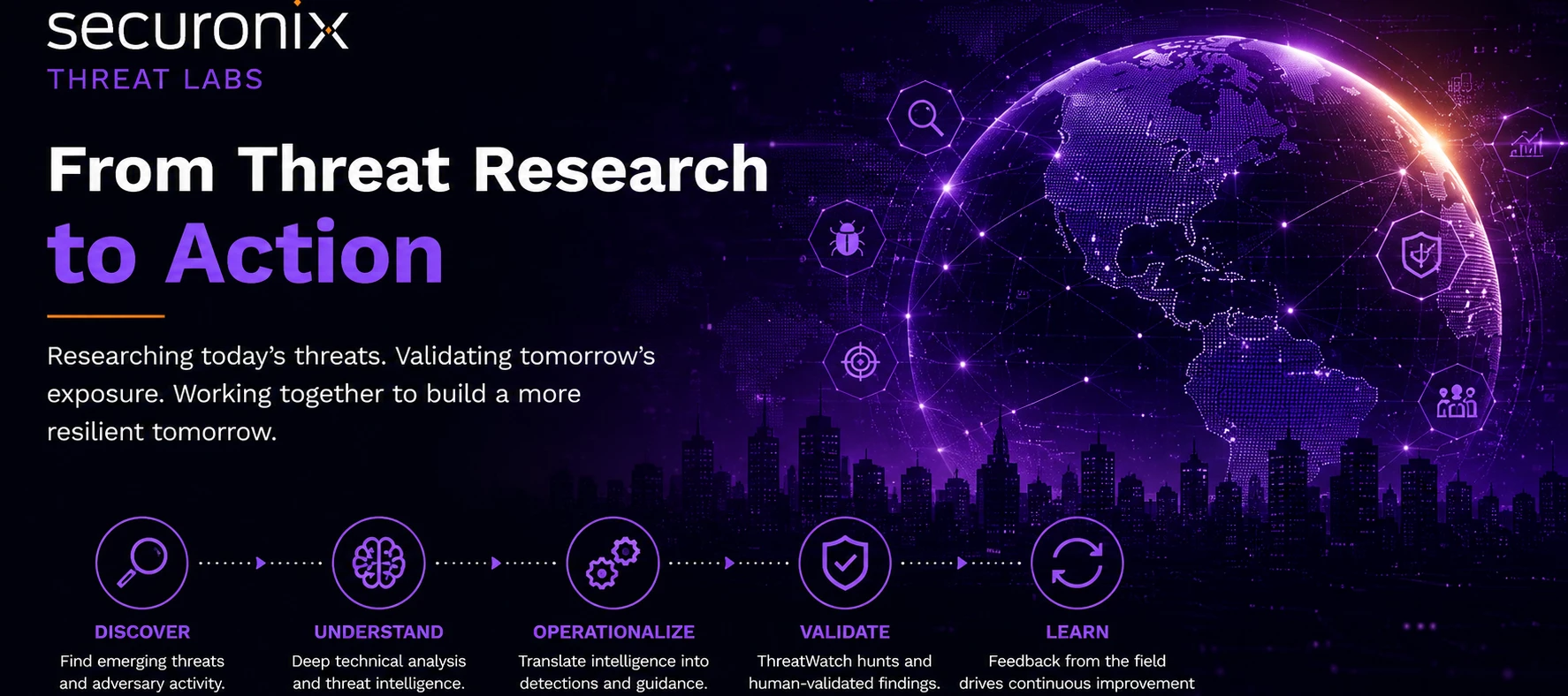

Welcome to Securonix Threat Labs: From Threat Research to Action
Cyber threats move quickly. New malware, vulnerabilities, campaigns, attack techniques, and indicators surface every day. Knowing that a threat exists, though, is only the first step.
Security teams still need to decide what deserves their attention. They need to understand how an adversary operates, identify the behaviors and artifacts that matter, turn that knowledge into something defenders can use, and, where appropriate, determine whether related activity may have appeared in their environment.
That is where we at Securonix Threat Labs focus our work.
We bring together threat research, intelligence analysis, detection-minded investigation, and expert-led exposure validation to help defenders move from threat awareness to informed action. This community is one place where we will share that work, add context around emerging threats, and talk directly with customers and partners about the research and intelligence shaping security operations today.
Meet Securonix Threat Labs
Within Securonix Threat Labs, our Threat Research team and ThreatWatch capability address different but closely connected parts of the intelligence-to-action process.
Threat Research: understanding the threat
Our Threat Research team investigates the adversaries, campaigns, malware, techniques, and other developments that may matter to defenders.
The team works across malware analysis, reverse engineering, adversary tactics, techniques, and procedures (TTPs), indicators of compromise, detection research, and observations gathered through honeypots and deception infrastructure. Researchers also draw on intelligence from the broader security community to build a clearer picture of how threats operate and what defenders should know about them.
The point is to add technical and defensive context. What is happening? How does the activity work? What behaviors or artifacts can defenders look for? How can that knowledge improve detection, hunting, or investigation?
That work can take the form of technical research, security advisories, detection-oriented insights, threat analysis, community contributions, and intelligence that informs other work across Securonix Threat Labs.
ThreatWatch: applying intelligence to exposure validation
For organizations using Securonix ThreatWatch, that intelligence can go a step further.
ThreatWatch is our expert-led, human-validated retrospective threat hunting capability. ThreatWatch analysts evaluate emerging intelligence, determine what is relevant for hunting, translate applicable indicators and behaviors into searches for supported security environments, and use targeted automation to run retrospective sweeps.
Human analysis remains a central part of that process. ThreatWatch analysts review search results, examine the available context, and determine which findings warrant customer investigation.
This helps reduce some of the manual work involved in turning intelligence into searches and reviewing the resulting activity, so customer teams can focus their attention on findings that deserve a closer look.
ThreatWatch works alongside a customer's existing real-time detection, incident response, remediation, and case management processes. It does not replace them.
From Threat Research to action
Threat Research and ThreatWatch perform different roles, but both support the same broader purpose: turning threat intelligence into knowledge and outcomes that defenders can use.
A simple way to think about the lifecycle is:
Discover → Understand → Operationalize → Validate → Learn
It is not a rigid pipeline. Research can inform hunting and detection work, ThreatWatch draws from a wider set of emerging intelligence sources, and lessons from customers and the field can feed back into future research.
Discover
Our researchers and analysts monitor a wide range of intelligence sources and conduct original research to identify emerging threats, adversary behaviors, malware, campaigns, and techniques worth investigating.
Understand
We look at how the activity works and what it means for defenders. That includes the indicators and behaviors associated with it, who or what may be targeted, and what telemetry could help identify related activity.
Operationalize
Relevant intelligence can be turned into detection content, threat hunting logic, technical guidance, advisories, or other material that security teams can put to use.
For ThreatWatch customers, applicable intelligence can also be translated into retrospective searches across supported customer security telemetry.
Validate
When ThreatWatch identifies potential activity, our analysts review the evidence and available context before deciding whether a finding warrants customer investigation.
The aim is not to generate another stream of raw alerts. It is to give customer teams useful context around activity that merits follow-up.
Learn
Research and hunting both create opportunities to learn.
Questions from customers, observations from the field, newly identified behaviors, and lessons from investigations can influence future research priorities, detection thinking, and threat hunting coverage.
Over time, that creates a feedback loop between research, intelligence, defensive application, and what security teams are seeing in real environments.
What this means for you
Whether you work in a SOC, threat intelligence, threat hunting, detection engineering, incident response, security leadership, or another defensive role, we want the work produced by Threat Labs to be useful in practice.
Our research is intended to help you understand emerging threats beyond the headline or indicator list. We want to explain the adversary behavior, technical details, and defensive relevance that can help your team make better decisions.
We also want to make intelligence easier to apply. Indicators have value, but behaviors, techniques, relationships, and detection context give defenders more ways to use what they know during hunting and investigation.
For ThreatWatch customers, this extends into exposure validation. Relevant emerging intelligence can be applied retrospectively to supported security telemetry, with human review helping focus attention on findings that warrant investigation.
This community also gives you a direct connection to the people doing the work. It gives us a place to provide additional context, answer questions, and discuss the threats and techniques we are researching with the customers and practitioners who use that information.
What you'll find in this community
The Threat Research & Intelligence community is where we will share and discuss work from across Securonix Threat Labs.
You can expect to find content such as:
-
Original Securonix Threat Labs research and technical analysis
-
Emerging threat and campaign analysis
-
Malware and adversary research
-
Security advisories and threat context
-
TTP-focused and detection-oriented insights
-
Threat hunting and defensive guidance
-
Additional context from our researchers and analysts
-
Educational updates related to Threat Labs and ThreatWatch
We want the material shared here to help you understand what is changing in the threat environment and what those changes may mean for defenders.
Join the conversation
We want this community to be a place for discussion, not simply a publishing feed.
If a piece of research raises a question, you want more technical context, or you want to discuss how an emerging threat or technique could affect defensive strategy, join the conversation. Our researchers and analysts welcome questions and discussion around the research and intelligence we share here.
Your perspective helps us as well. The questions customers ask, the topics that need more explanation, and the areas where defenders need better visibility can all help inform how we approach future work.
For customer-specific investigations, ThreatWatch findings, product support, or incident-related requests, please continue to use the appropriate Securonix support and customer engagement channels. Sensitive or environment-specific information should not be posted in the community.
From intelligence to better security outcomes
Threat intelligence has the most value when defenders can use it to make better decisions.
At Securonix Threat Labs, we want to help you move from knowing that a threat exists to understanding how it works, why it matters, and what you can do with that knowledge.
We look forward to sharing our work with you and hearing from you along the way.