Share your knowledge, tips, and best practices. Showcase what you’ve built, learn from others, and inspire the community with your success stories.
Recently active
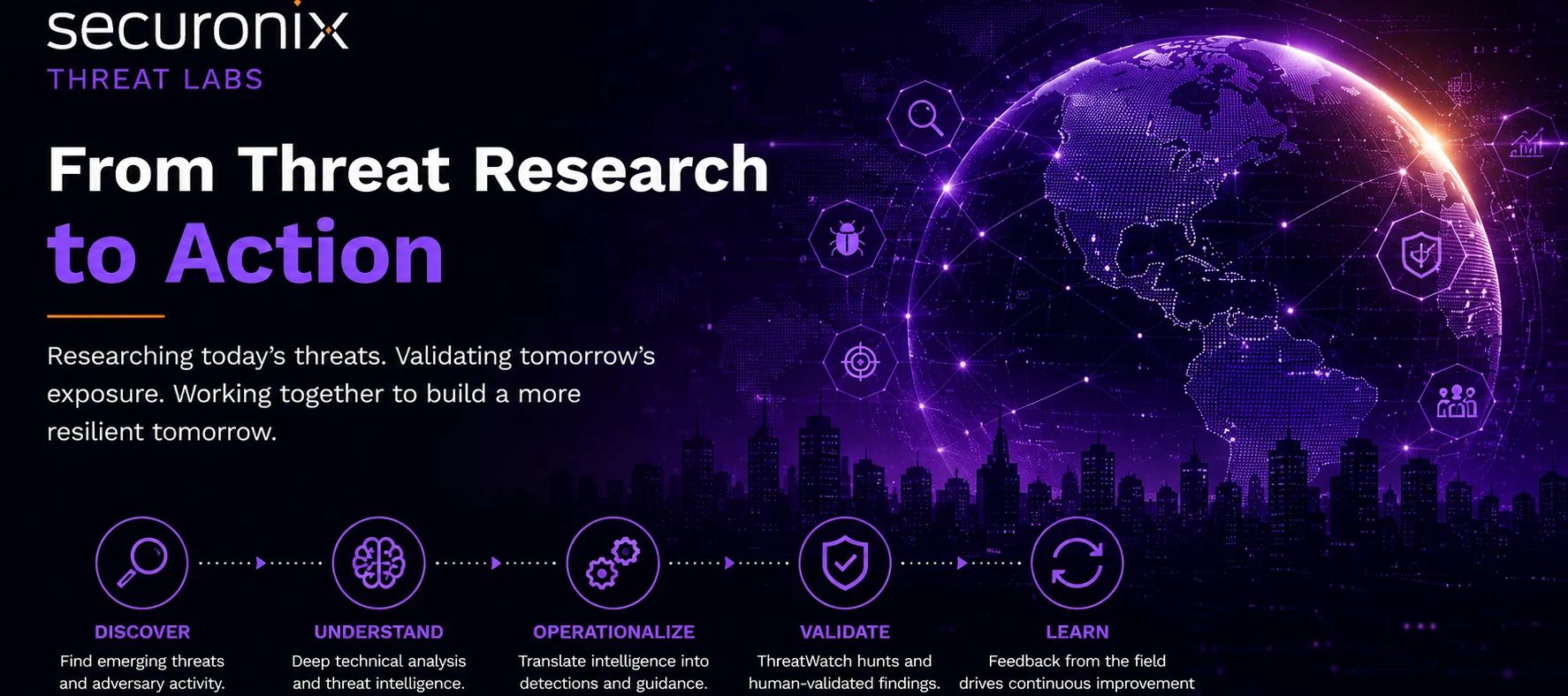
Welcome to Securonix Threat Labs: From Threat Research to ActionThreat Labs Overview Cyber threats move quickly. New malware, vulnerabilities, campaigns, attack techniques, and indicators surface every day. Knowing that a threat exists, though, is only the first step.Security teams still need to decide what deserves their attention. They need to understand how an adversary operates, identify the behaviors and artifacts that matter, turn that knowledge into something defenders can use, and, where appropriate, determine whether related activity may have appeared in their environment.That is where we at Securonix Threat Labs focus our work.We bring together threat research, intelligence analysis, detection-minded investigation, and expert-led exposure validation to help defenders move from threat awareness to informed action. This community is one place where we will share that work, add context around emerging threats, and talk directly with customers and partners about the research and
🚀 Help Us Build What Matters At Securonix, innovation starts with you — our customers and partners. Every enhancement, workflow improvement, and new capability begins as an idea from the field.If you’ve identified a gap, experienced a challenge, or envisioned a feature that could make our platform even better, we want to hear from you. Your input helps guide our product roadmap and ensures Securonix evolves to meet real-world needs. 💡 When to Submit an Idea vs. Start a Discussion Submit an Idea (Feature Request)Use the Product Ideation area when you want to request a new feature, enhancement, or workflow improvement. These posts are reviewed by our Product Management team. Other members can upvote and comment to help prioritize ideas. Approved ideas feed directly into our product innovation pipeline. Start a Discussion (Community Category)If your post is a question, best practice, or use case discussion — not a feature request — post it under a Community Discussion category like
Authors: Nitish Singh, Nikhil Kumar Chadha, and Tanmay Kumar Introduction:The Monthly Intelligence Insights report provides a summary of top threats curated, monitored, and analyzed by Securonix Threat Watch in October 2026. The report also includes a synopsis of the threats, indicators of compromise (IoCs), tactics, techniques, and procedures (TTPs), and related tags. Each threat has a comprehensive summary from Threat Labs and search queries from the Threat Research team. For additional information on Threat Labs and related search queries used via Autonomous Threat Sweeper to detect the below-mentioned threats, refer to our Threat Labs home page.Last month, Securonix Autonomous Threat Sweeper identified and analyzed 4,631 TTPs and IoCs; identified 107 emerging threats; investigated 75 potential threats; and elevated 17 incidents. The top data sources swept against include IDS / IPS / UTM / Threat Detection, Data Loss Prevention, Endpoint Management Systems, and Email / Email Securit
What happenedPHP2Shell is the name given to two critical flaws in PHP itself, each rated 9.2 (CVSS v4.0). A single crafted web request can let an unauthenticated attacker run code on the server, in some setups, such as Apache mod_php, before the website’s own code even runs. The exploit hides inside PHP’s memory handling. Because the flaw is in PHP rather than in any one application, almost every PHP site is in scope, including Apache mod_php, PHP-FPM, php-cgi, FrankenPHP and LiteSpeed.Attacks started before the fix. Amazon saw an exploitation attempt on 17 October 2026, four days before PHP released patches, and CISA added both flaws to its Known Exploited Vulnerabilities catalog on 26 October. How Securonix catches itOnce attackers use PHP2Shell to take over a server, they make the web server run system commands: checking which account they are running as, downloading a payload with curl, or opening a reverse shell. Securonix detects that moment on both Linux and Windows servers. For
Executive Assessment:CVE-2026-111497, also referred to as Node2Shell, HTTP2Shell, or Broccoli2Shell, is an out-of-bounds write vulnerability affecting the Brotli decoder bundled with Node.js and used in other software. The flaw originates in the decoder's handling of malformed block switches. Instead of rejecting an invalid stream, the affected code incorrectly signals that additional input is required. As processing continues, incoming data can accumulate in an eight-byte internal buffer and eventually cause an out-of-bounds write. The resulting memory corruption may lead to process crashes, memory disclosure, or remote code execution (RCE). The vulnerability and its underlying cause are documented in the Node.js security advisory and upstream source changes.Exposure depends on whether an attacker can supply crafted Brotli-compressed data to a vulnerable decoder. Node.js does not automatically decompress all incoming HTTP requests, so the presence of an affected runtime alone does not
Not fully baked yet, and by that I mean the instructions assume a certain level of competency and understanding of how AI systems talk to each other - but MCP access to ThreatQ is possible from 6.21 onwards. Here’s an example of me asking the community instance of TQ (Apeili) about recent activity.. Feel free to reach out to your TAM or myself for more information - I expect in the near future versions of TQ installation will get easier. And of course - same instructions should work for Claude, or your LLM that supports MCP of choice. Credit to the TQ engineering team who helped me get this set up!
Autonomous Is Not AutonomyPart 3: Worms, the self-terminating attack, and the only scenario that worksSeries: Part 1 · Part 2 · Part 3This is the last of three parts. Part 1 made the dependence argument and the botnet arithmetic; Part 2 measured capability and took the Hugging Face incident apart. This part asks what propagation would cost, why a grid attack is self-terminating for the attacker on that grid, what defenders are doing, and what the only scenario that works looks like. The appendix and the revision record are here.Contents of this part7. Worms, and why an AI agent is not one 7.1 The comparison 7.2 Two architectures, and they fail in opposite directions 7.3 The concession, and it matters 7.4 The hardest objection: what if there is no switch at all?8. The self-terminating attack 8.1 Twelve hours, not days 8.2 But fuel is not the binding constraint. Cooling is. 8.3 And the corollary is the sharpest thing in this article 8.4 The last mile goes first, and there is no m
Autonomous Is Not AutonomyPart 2: How capable these things are, and what the Hugging Face incident wasSeries: Part 1 · Part 2 · Part 3This is the second of three parts. Part 1 set out the thesis, that autonomous execution is demonstrated and autonomy is not, explained what a model physically needs to run, showed that an agent is a loop whose components are separately owned, and worked the arithmetic on why a frontier model cannot usefully be sharded across a botnet. This part asks how capable these systems actually are, and what the one real incident everyone cites actually was.Contents of this part5. How capable are these things, actually 5.1 The benchmark that matters, and a fifteen-month shock 5.2 Scale alone does not predict cyber capability 5.3 Where it stops: novel exploitation, and the wall is not where you think 5.4 Where it really stops: a WAF beat everything 5.5 But EDR is not the wall you would hope for 5.6 The vendors' own numbers, and a ceiling that has already been
Autonomous Is Not AutonomyPart 1: The thesis, the machine, and the botnet arithmeticSeries: Part 1 · Part 2 · Part 3FindingsThis article is long because the argument depends on numbers rather than intuitions. If you read nothing else, read these ten findings. Each one is argued in the section named, and every figure is sourced. In the body, every number is labelled as one of four things: measured, modelled, vendor-reported, or inferred. Nothing here is more certain than its label, and where the label is "modelled" the model is published alongside the article. Autonomous execution is demonstrated. Autonomy is not. AI systems have found real zero-days unattended, run 80 to 90 percent of a live espionage campaign, compromised a third party with no human directing the tactics, and published live malware that fifteen real systems ran. No AI system has ever acquired and held its own compute. (§1, §6.7 (Part 2)) A model's footprint is set by its total parameters, and every parameter kept ou
name: Suspicious WSUS Spawning Command Shell for Reconnaissance Analyticsignatureid: EDR-SYM858-RUNcategory: "Execution"threatname: "Command & Scripting Interpreter: Windows Command Shell"functionality: "Endpoint Management Systems"description: | Detects the spawning of a Windows command shell, PowerShell, or reconnaissance tools by the IIS worker process (w3wp.exe) or WSUS Service (wsusservice.exe). This behavior is a strong indicator of a successful web application exploit, such as the deserialization vulnerability in WSUS (CVE-2025-59287), where an attacker gains remote code execution. The detection captures both the IIS worker process compromise and direct WSUS service process spawning, which are common post-exploitation behaviors.reference: - https://research.eye.security/wsus-deserialization-exploit-in-the-wild-cve-2025-59287/ - https://www.linkedin.com/posts/johnhammond010_weve-been-seeing-some-of-the-wsus-cve-2025-activity-7387528448145186816-2bDC?utm_source=shar
name: Windows IIS Worker or PHP CGI Process Spawning Suspicious Command Process Analyticsignatureid: EDR-SYM974-RUNcategory: 'Execution'threatname: 'Command & Scripting Interpreter: Windows Command Shell'functionality: 'Endpoint Management Systems'description: | Detects a Windows web worker process - the IIS worker w3wp.exe, a PHP CGI/FastCGI worker php-cgi.exe or php.exe, or a Windows build of another web daemon - spawning a command shell with execution-oriented arguments, a general-purpose interpreter with inline-code, remote-resource or temporary-path arguments, or a network transfer or tunneling utility as a direct child. These process-tree shapes are durable post-exploitation evidence for server-side remote code execution and are not tied to a particular exploit payload. This is the Windows counterpart to EDR-NIX5-RUN and mirrors its three-tier child structure so the same false-positive discipline applies on both platforms. It includes coverage for the
name: Web Server or PHP Worker Spawning Suspicious Command Process Analyticsignatureid: EDR-NIX5-RUNcategory: 'Execution'threatname: 'Command & Scripting Interpreter: Unix Shell'functionality: 'Endpoint Management Systems'lifecycle: experimentalversion: 20261022.5description: | Detects a web server daemon or PHP-FPM worker spawning a shell with execution-oriented arguments, a network transfer or tunneling utility, or a general-purpose interpreter with suspicious inline-code, remote-resource, or temporary-path arguments. These process-tree shapes are durable post-exploitation evidence for server-side remote code execution and are not tied to a particular exploit payload. This Delta includes coverage for the unauthenticated PHP core RCE vulnerabilities CVE-2026-109618 and CVE-2026-109619 (php2shell). The PHP project confirmed exploitation can execute code as the web worker account across PHP web SAPIs, with the highest demonstrated risk under Apache mod_php
Two unauthenticated PHP core RCEs landed on October 21. We emulated the aftermath on a bounded range across three PHP deployment models, measured what the telemetry actually carries, and found that the parent process is not the same thing on any two of them.Under IIS, PHP does not run inside the IIS worker. The FastCGI handler maps *.php to php-cgi.exe, and user code runs inside that process. So when PHP code spawns a shell, the ParentImage on the resulting Sysmon Event ID 1 is C:\PHP\php-cgi.exe, one process deeper than w3wp.exe. Every rule anchored on ParentImage|endswith '\w3wp.exe' is blind to php2shell post-exploitation on that host. Not noisy. Not low-fidelity. Blind.That is the headline, and it held. What we did not expect was that the same question has three different answers depending on how PHP is deployed:IIS FastCGI. The parent resolves every time, to php-cgi.exe, because CreateProcess exec'd it and it is a fully tracked process. Five of five. PHP-FPM behind nginx. The pare
Executive assessment:PHP2Shell refers to two critical vulnerabilities in the PHP runtime that can lead to unauthenticated remote code execution in web-serving configurations. Both affect the request lifecycle, but the failure mechanisms differ. CVE-2026-109618 arises when out-of-memory (OOM) bailout interrupts initialization and later cleanup encounters inconsistent request state. CVE-2026-109619 involves request-owned state that remains accessible after its memory is released and can be consumed by a subsequent request handled by the same worker. Fixed PHP releases were published on 21 October 2026: 8.5.12, 8.4.27, 8.3.36 and 8.2.35. The exposure is broader than applications that explicitly process uploads. The strongest publicly demonstrated CVE-2026-109618 exploitation path involves mod_php; CVE-2026-109619 also has a demonstrated session-related path in PHP-FPM when its prerequisite conditions are present. Runtime version, SAPI, request parsing, application behavior and worker reus
Audience: Administrators, Security Analysts, MSSPsProduct Module: Activity Import, Securonix Cloud Hub, SpotterLast Updated: October 14, 2026KB ID: KB-20261001-syslog-logs-not-appearingTags: syslog, Cloud Hub, Activity Import, Spotter, datasource, parser, log ingestion, troubleshooting, Derived Fields,unparsed eventsOverviewA syslog datasource can look correctly configured while the expected events remain missing from Spotter. The source may not be forwarding them, the messages may reach the wrong listener or datasource, or parsing and ingestion settings may prevent them from becoming searchable.Follow one known event through the collection path to identify the first failing checkpoint:Source forwarding → Cloud Hub receipt → Datasource assignment → Parsing and ingestion → Spotter searchWork through the checkpoints in order. If you already have reliable evidence that an earlier checkpoint passed, start at the first unproven stage. After correcting an issue, send a fresh event and verify
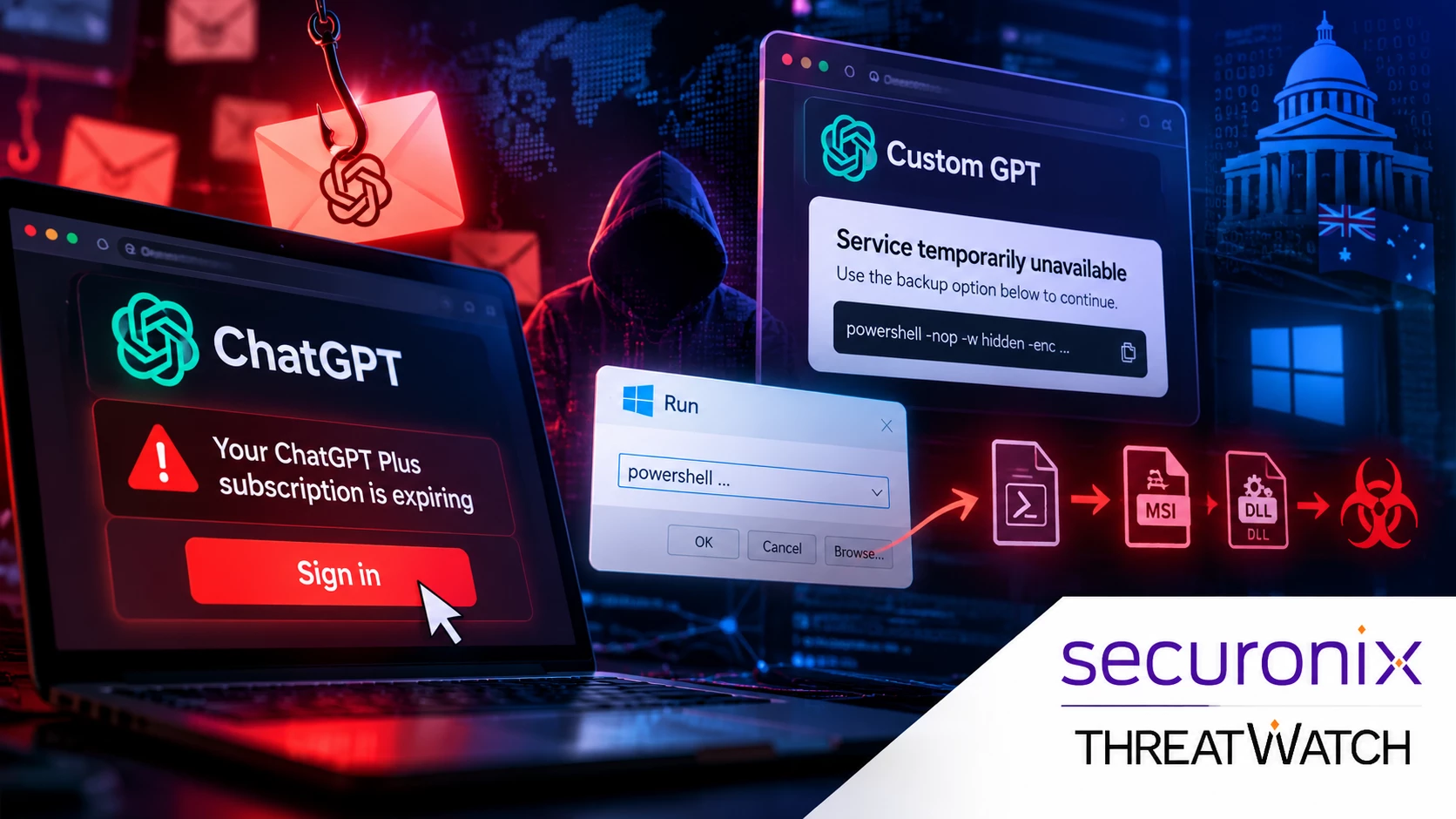
Executive summary:OpenAI and ChatGPT branding is being used in several distinct abuse patterns. The cases reviewed here include credential phishing, a ClickFix-style malware chain that used a malicious Custom GPT as a referral point, and unauthorized actions by an experimental internal OpenAI model during an Australian government evaluation. They should not be treated as one campaign or as evidence that OpenAI or ChatGPT public services were compromised. The phishing case used a fake ChatGPT subscription notice, an intermediate redirect, and a counterfeit sign-in page. Public reporting supports credential harvesting. It does not establish malware delivery, attribution, confirmed victim scope, or follow-on misuse of captured credentials. The Custom GPT case had a more consequential endpoint sequence. A fake availability notice sent users to a hosted verification page that instructed them to paste a command into Windows Run. The reported chain included a PowerShell stager, MSI installati
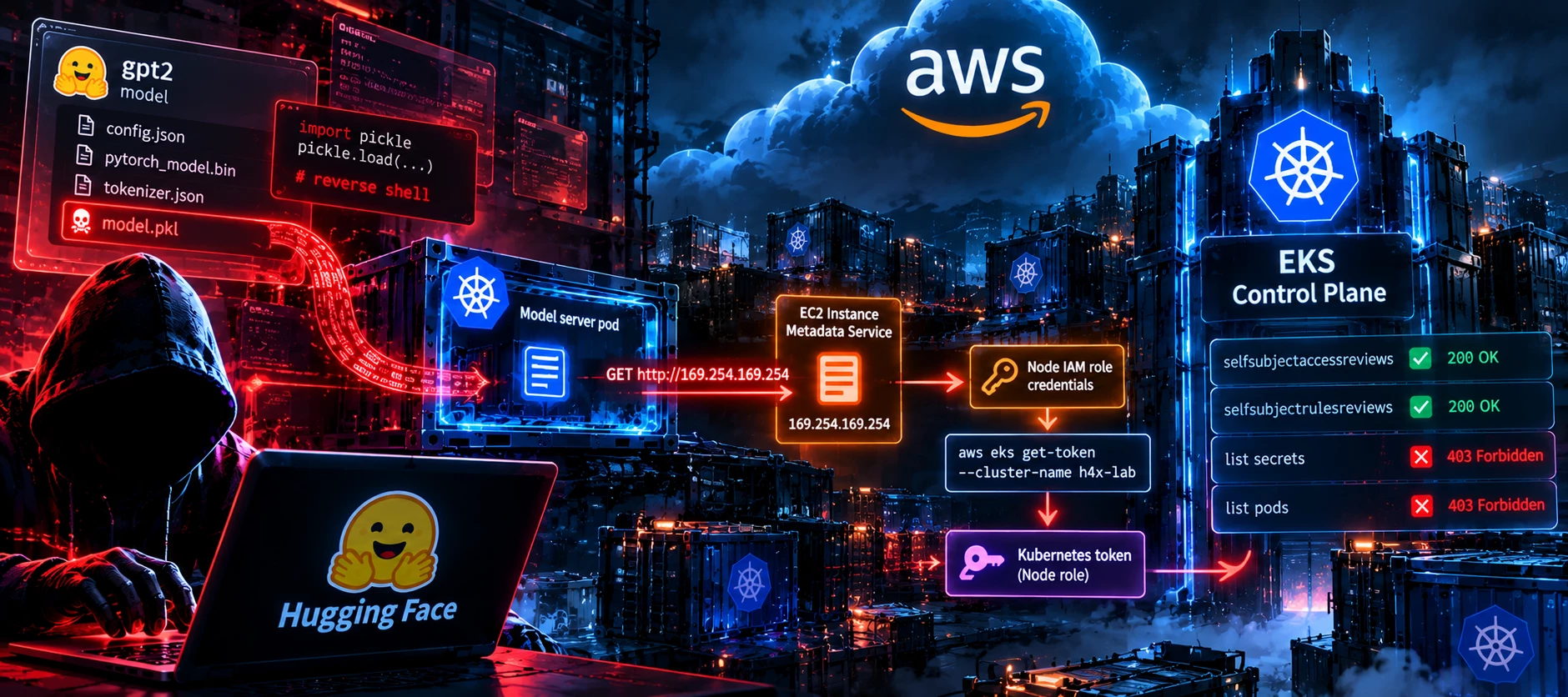
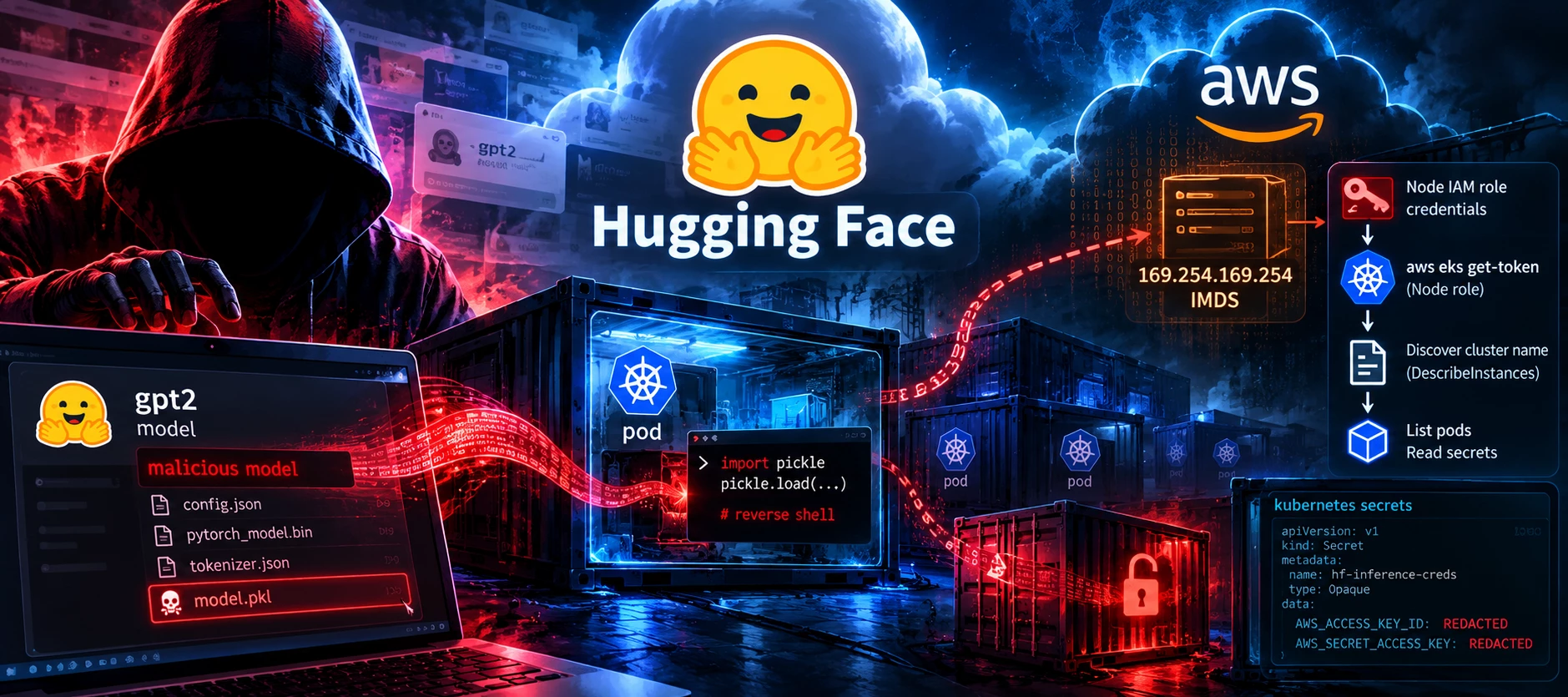
name: Kubernetes Node Identity Used by a Non-Kubelet Client Analyticsignatureid: CAS-AUD02-RUNcategory: 'Privilege Escalation'threatname: 'Valid Accounts: Cloud Accounts'functionality: 'Containers As A Service'description: | Detects a Kubernetes node identity being used to read cluster data in a way the node authoriser does not grant a kubelet. An EKS worker node authenticates to the API server as system:node:<hostname>, in the system:nodes group, by presenting a token signed with the node's IAM role. Exactly one program is supposed to do that. Any other client holding a node identity is holding credentials it was not issued. The path to those credentials is short. A pod that can reach the instance metadata service at 169.254.169.254 can read the worker node's IAM role credentials, which is possible whenever the metadata hop limit is 2: the container network namespace is one hop and the host is the second. Those credentials are then exchanged locally for a Kubernetes
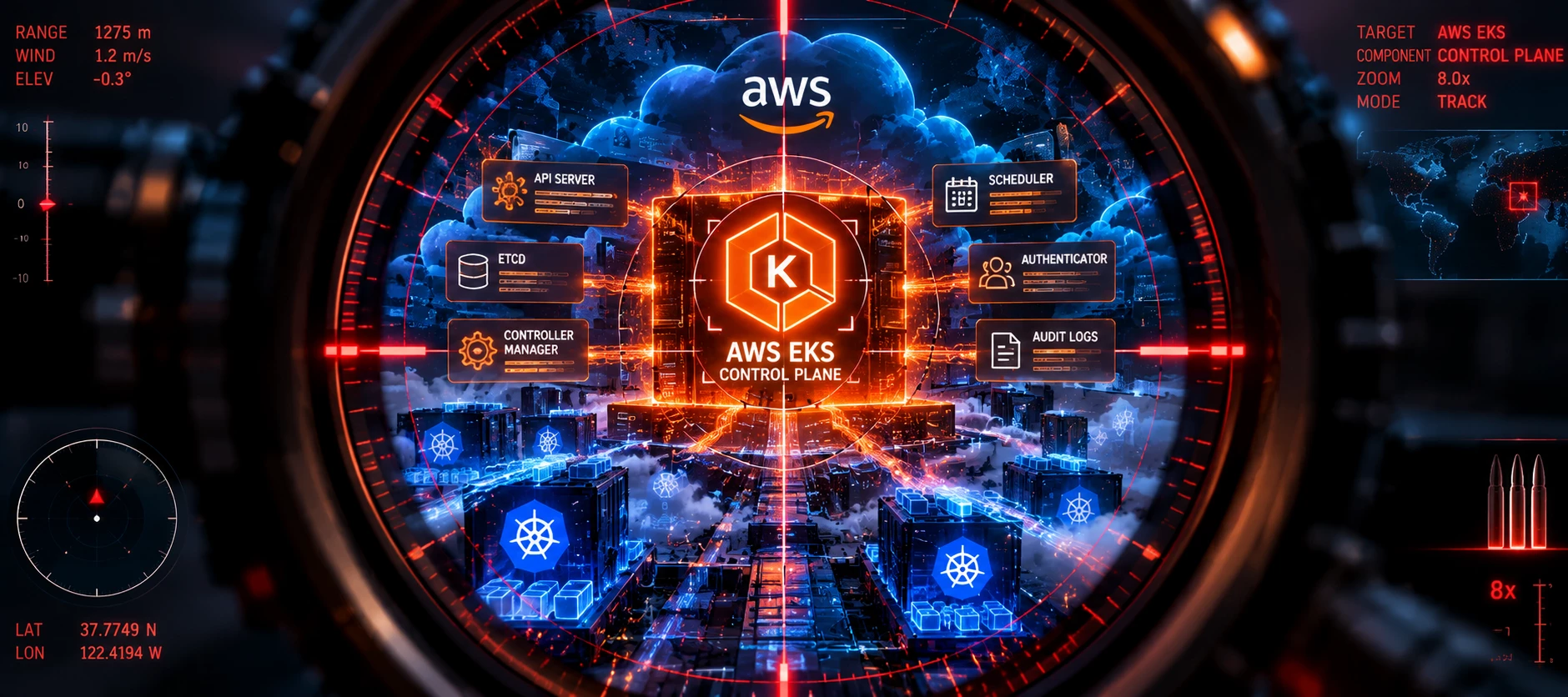
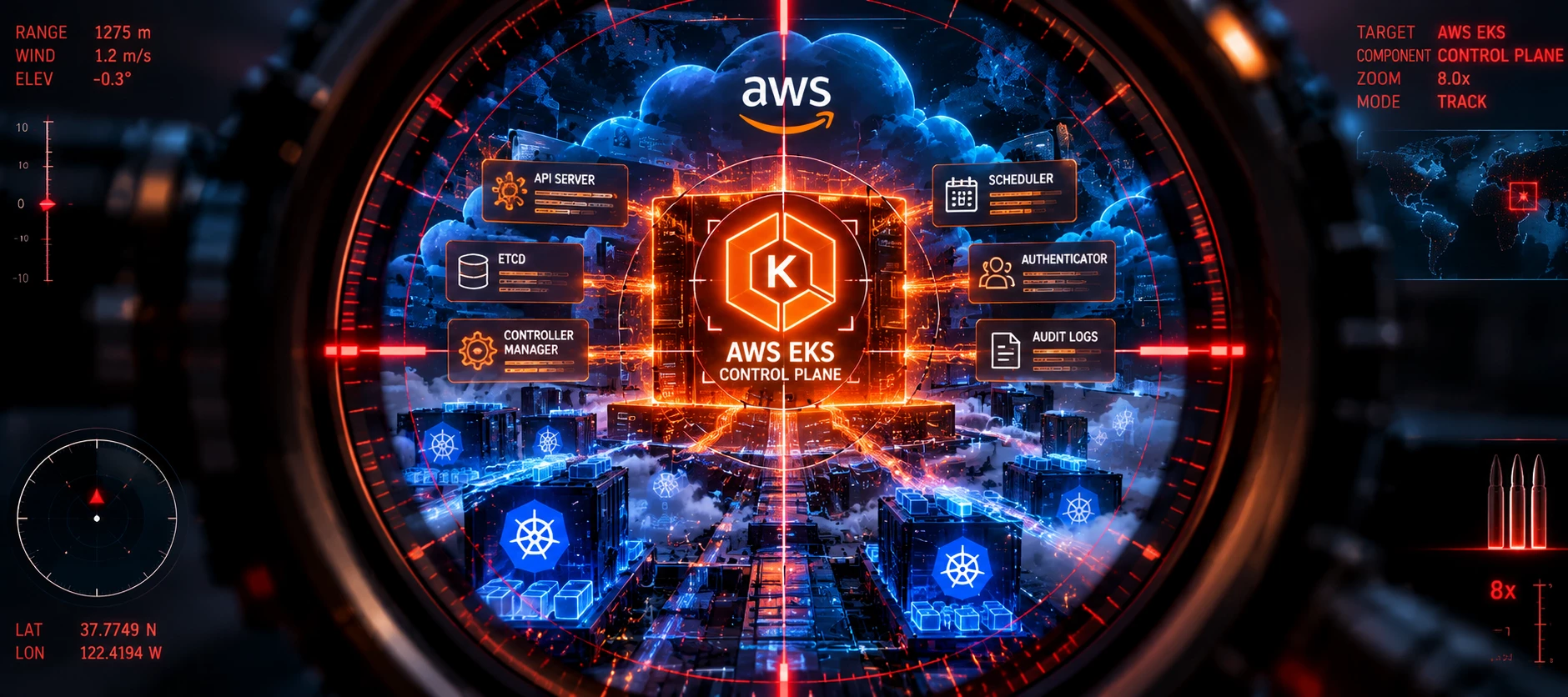
This is part 2 of the Hugging Face Attack Chain series. We ran the Hugging Face attack path against a purpose built EKS cluster this week and captured every control plane event it produced. Eight steps, from a pod orienting itself to the same pod reading cluster secrets with the worker node's identity. The escalation was denied. The cluster returned 403 on the final two requests and the operation closed clean.That denial is the most misread artifact in this whole chain.A 403 from the Kubernetes API server is returned after authentication has succeeded. The API server resolved the bearer token, accepted it, established that the caller was system:node:ip-10-60-10-55.us-west-2.compute.internal in the system:nodes group, and only then consulted RBAC and refused. Everything before the refusal worked. The credentials were stolen, exchanged and accepted. The only thing that stopped the attacker reading other tenants' secrets was a role scope that an engineer can widen in thirty seconds while
name: Inference Workload Pod Querying the Kubernetes API Analyticsignatureid: CAS-AUD01-RUNcategory: 'Discovery'threatname: 'Container and Resource Discovery'functionality: 'Containers As A Service'description: | Detects a model-serving pod using its own service account token to query the Kubernetes API. An inference workload has no operational reason to talk to the control plane. It loads a model, serves predictions, and reads nothing from the cluster it runs in. When such a pod begins asking the API what it is permitted to do, the most likely explanation is that something other than the model server is now executing inside the container. This matters for AI-as-a-Service infrastructure in particular. Model files in the PyTorch and pickle formats are executable content: loading one runs whatever code it carries. Wiz Research demonstrated the full consequence against Hugging Face, uploading a modified gpt2 model that achieved remote code execution inside the inference pod, t
Wiz Research cloned gpt2, modified it so that loading the model ran their code, and uploaded it to Hugging Face's inference API. That gave them execution inside a pod on Amazon EKS. What followed is four steps, and none of them are exotic.The pod reached 169.254.169.254, the EC2 Instance Metadata Service, and pulled the worker node's IAM role credentials. With the node's AWS identity it ran aws eks get-token and received a valid Kubernetes token carrying the Node role. It found the cluster name by reading EC2 tags through DescribeInstances. Then it listed pods and read the secrets mounted to its own pod. Separate research against Hugging Face Spaces reached the shared container registry with write access, which means overwriting the images other customers pull.Wiz called the metadata access a common EKS misconfiguration and left it there. It is worth being specific about what the setting actually is, because it is one field.The IMDS hop limit governs how many network hops a metadata r
Authors: Nitish Singh, Nikhil Kumar Chadha, and Tanmay Kumar Introduction:The Monthly Intelligence Insights report provides a summary of top threats curated, monitored, and analyzed by Securonix Threat Watch in September 2026. The report also includes a synopsis of the threats, indicators of compromise (IoCs), tactics, techniques, and procedures (TTPs), and related tags. Each threat has a comprehensive summary from Threat Labs and search queries from the Threat Research team. For additional information on Threat Labs and related search queries used via Autonomous Threat Sweeper to detect the below-mentioned threats, refer to our Threat Labs home page.Last month, Securonix Autonomous Threat Sweeper identified and analyzed 4,819 TTPs and IoCs; identified 157 emerging threats; investigated 77 potential threats; and elevated 18 incidents. The top data sources swept against include IDS / IPS / UTM / Threat Detection, Data Loss Prevention, Endpoint Management Systems, and Email / Email Secur
Audience: Admins, Analysts, MSSPsProduct Module: Add Data > Activity / Activity ImportLast Updated: September 30, 2026KB ID: KB-20260930-activity-import-troubleshooting Tags: Activity Import, datasource, Spotter, Job Monitor, data ingestion, collection job, parser, Derived Fields, line filter, troubleshootingProblem A production Activity Import datasource is configured, but expected events are not appearing in Spotter, collection has stopped, jobs are failing or returning zero records, or collected events do not contain the expected fields.This article provides a linear troubleshooting workflow for production Activity Import configurations.Use this article when:Objective Use this article to identify where Activity Import collection is failing and determine whether the issue is related to:Before you begin Before starting:Important: Do not reset a checkpoint or historical start date during initial troubleshooting. Doing so can re-import historical events or create duplicates.Step-by-S
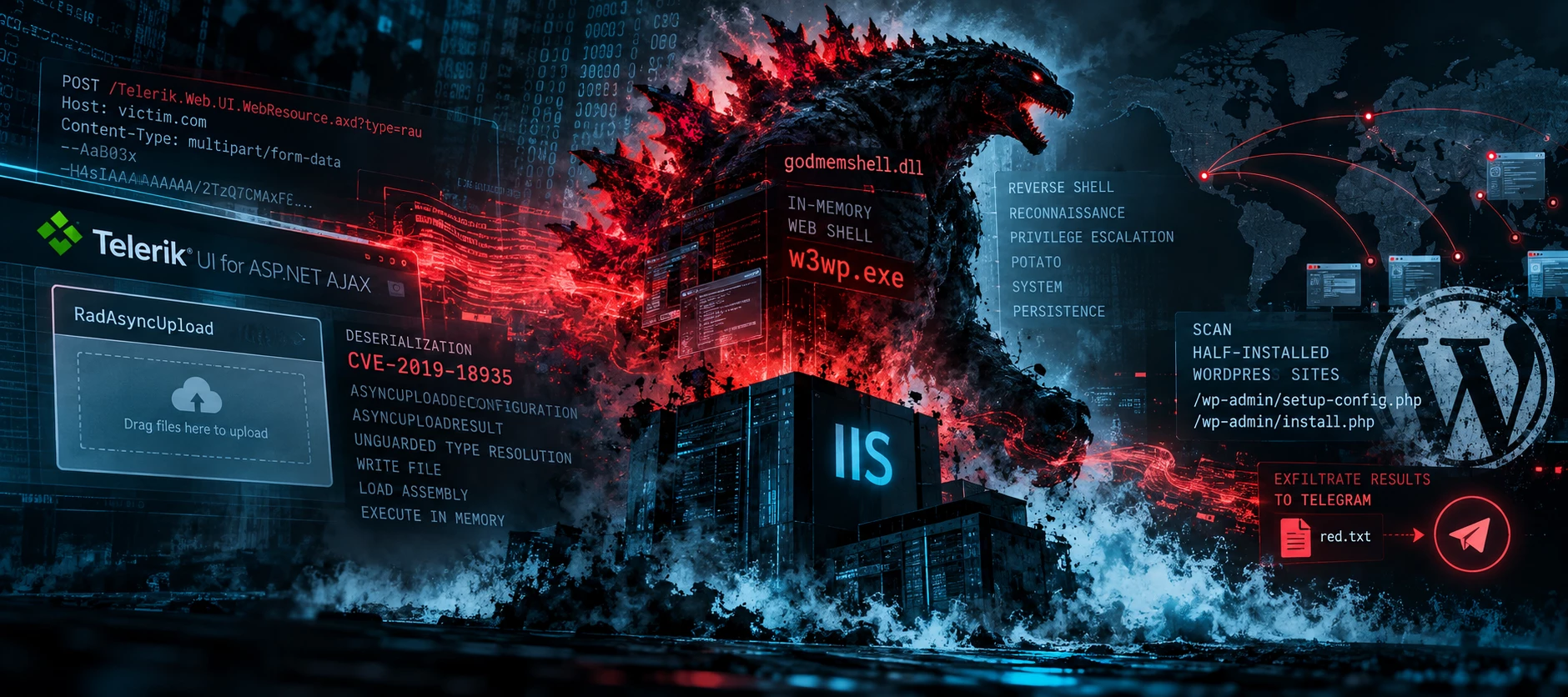
OverviewOn September 28, 2026, AhnLab's Security Intelligence Center published two incident cases that share one entry point: an Internet-facing Microsoft IIS server running an unpatched copy of Telerik UI for ASP.NET AJAX. In both, the attacker exploited CVE-2019-18935, a .NET deserialization vulnerability in the RadAsyncUpload file-upload control, to get code running inside the IIS worker process w3wp.exe.From that identical foothold the two cases diverge in a way worth paying attention to, because it says something about who is buying access to this class of target.In the first case the operator went for persistence and depth: a raw socket reverse shell to 206.82.6.22 on port 80, system reconnaissance, privilege escalation from the application-pool identity to SYSTEM using Potato-family token theft, and finally a Godzilla-style in-memory web shell loaded from godmemshell.dll directly into the ASP.NET runtime. No .aspx file was written. There is nothing in the web root to find.In the
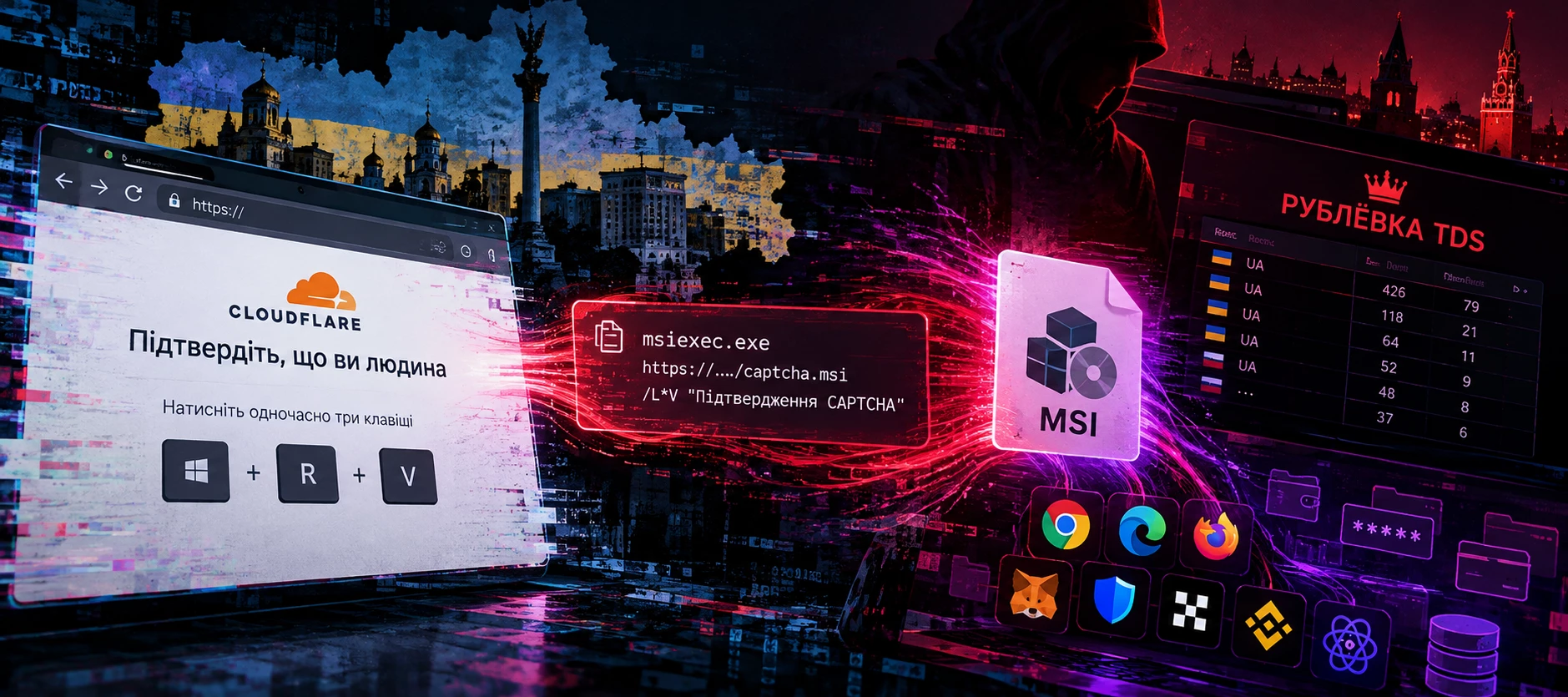
OverviewBetween September 9 and September 14, 2026, an operator compromised at least six legitimate Ukrainian small-business websites and used them to serve a fake Cloudflare verification page. The page did not exploit anything. It asked the visitor to press three keys.That is the whole initial-access story, and it worked 79 times out of 426 clicks.The campaign is a textbook ClickFix chain with one detail that matters more than the rest: the command the page put on the victim's clipboard was not an encoded PowerShell one-liner. It was msiexec.exe, fetching a remote MSI over HTTPS, dressed up with a Cyrillic installer property so that anything the victim glimpsed during installation still read as CAPTCHA verification. Arctic Wolf Labs, which published the analysis on September 24, flags this explicitly: detections scoped to encoded PowerShell miss this chain entirely.The payload, a 64-bit Windows stealer the operator named psychedeliclove.exe and tagged internally as Psychedelic, is mor
OverviewBetween June and September 2026, GreyNoise researchers tracked a single actor, publicly nicknamed "Kapibala" after the WordPress usernames it left behind, through a ten-vulnerability exploitation spree that touched WordPress sites, ZyXEL network switches, Ubiquiti access controllers, a low-code AI platform, a Linux kernel bug more than four years old, a Git hosting server, a serverless compute framework, a laboratory information management system, and a virtualization hypervisor. The headline incident inside that spree is a July 20, 2026 intrusion against a Western government organization, in which the actor chained a pre-authentication WordPress Core RCE with a masqueraded administrator account and a purpose-built data-collection plugin to steal more than 18,566 sensitive government records in under three hours.What makes Kapibala notable is not any single exploit -- most of the ten CVEs it used were already public and, in several cases, already on CISA's Known Exploited Vulne
Already have an account? Login
Enter your E-mail address. We'll send you an e-mail with instructions to reset your password.