Share your knowledge, tips, and best practices. Showcase what you’ve built, learn from others, and inspire the community with your success stories.
Recently active
We would like to see the normalization of risk scores. This is essential for easy of use within the indicator scoring policy. We have came across this issue with Domain Tools, AbuseIPDB, and AlienVault. Reference the Google Threat Intelligence CDF is an example integration that provides this normalization option.
Hi Community, ThreatQ currently has the ability to parse PDFs, CSVs, and other plain text files for IOCs. How useful would it be to add support for parsing Excel files? Here are some additional questions that will help us understand how you may use ThreatQ and how you could benefit from an Excel parser:Do the Excel files that you import have a standard format/columns? How often are you wanting to import & parse Excel files? Would you benefit from being able to automate this parsing job (assuming the formats are standard)? Do the Excel files that you import have multiple sheets? Are you often wanting all sheets parsed, or generally just one? How important is it that context from the same row is stored with the corresponding IOC? Where are you receiving these Excel files from? You don’t need to expose any specific names, but just generally (i.e. commercial vendors, OSINT sources, gov agencies, etc.) Interested to hear some thoughts!
Securonix ThreatWatch Monthly Intelligence Insights – July 2026 Authors: Nitish Singh, Nikhil Kumar Chadha, and Tanmay Kumar Introduction: The Monthly Intelligence Insights report provides a summary of top threats curated, monitored, and analyzed by Securonix Threat Watch in July 2026. The report also includes a synopsis of the threats, indicators of compromise (IoCs), tactics, techniques, and procedures (TTPs), and related tags. Each threat has a comprehensive summary from Threat Labs and search queries from the Threat Research team. For additional information on Threat Labs and related search queries used via Autonomous Threat Sweeper to detect the below-mentioned threats, refer to our Threat Labs home page. Last month, Securonix Autonomous Threat Sweeper identified and analyzed 4,403 TTPs and IoCs; identified 129 emerging threats; investigated 89 potential threats; and elevated 11 incidents. The top data sources swept against include IDS / IPS / UTM / Threat Detection, Data Loss Pr
Audience: ThreatQ Administrators, Support Engineers, Hosted Operations EngineersProduct Module: ThreatQ → System Configurations → AI (Threat Research Agent)Last Updated: August 5, 2026KB ID: KB-20260805-ai-llm-settings-missingTags: ThreatQ, Threat Research Agent, AI, LLM, Agentic Assistance, BYOM, System Configurations, Licensing, SaaS, On-PremisesTable of ContentsProblem Objective About the Threat Research Agent Before You Begin Why the AI / LLM Settings Page Is Missing Cause 1: Threat Research Agent Is Not Licensed Cause 2: Unsupported ThreatQ Version Cause 3: Insufficient User Permissions Cause 4: Backend Services Have Not Been Enabled Enable the Threat Research Agent Hosted (SaaS) On-Premises Verification Checklist Troubleshooting Logs and Diagnostics Host Logs Kubernetes Logs When to Contact Support Summary Problem After installing or upgrading ThreatQ, the AI or LLM Settings page is not visible under System Configurations.Without this page, administrators cannot configure
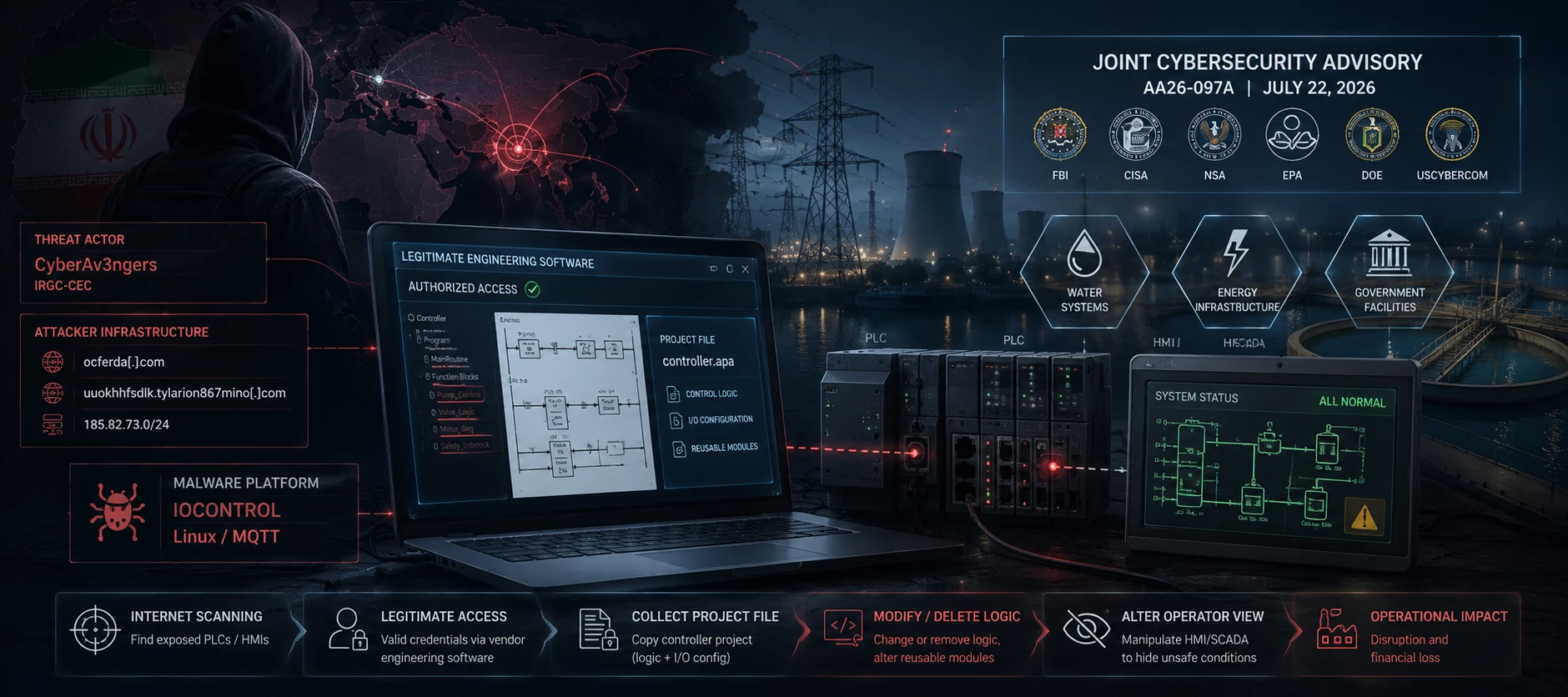
OverviewOn July 22, 2026, six U.S. federal agencies (the FBI, CISA, NSA, the EPA, the Department of Energy, and U.S. Cyber Command) jointly updated an advisory (AA26-097A) first issued in April 2026, warning that nation-state actors are still actively exploiting internet-facing programmable logic controllers (PLCs) across U.S. government facilities, water systems, and energy infrastructure.What makes this campaign notable is not a new vulnerability. The attackers do not exploit a software bug at all; they scan the internet for exposed PLCs and human-machine interfaces (HMIs), then connect using the vendor's own legitimate engineering software with working credentials, indistinguishable at the network level from an authorized technician logging in to do maintenance. Once inside, they copy the controller's project file (the blueprint that encodes both control logic and I/O configuration), modify or delete pieces of that logic, including reusable code modules shared across many devices, a
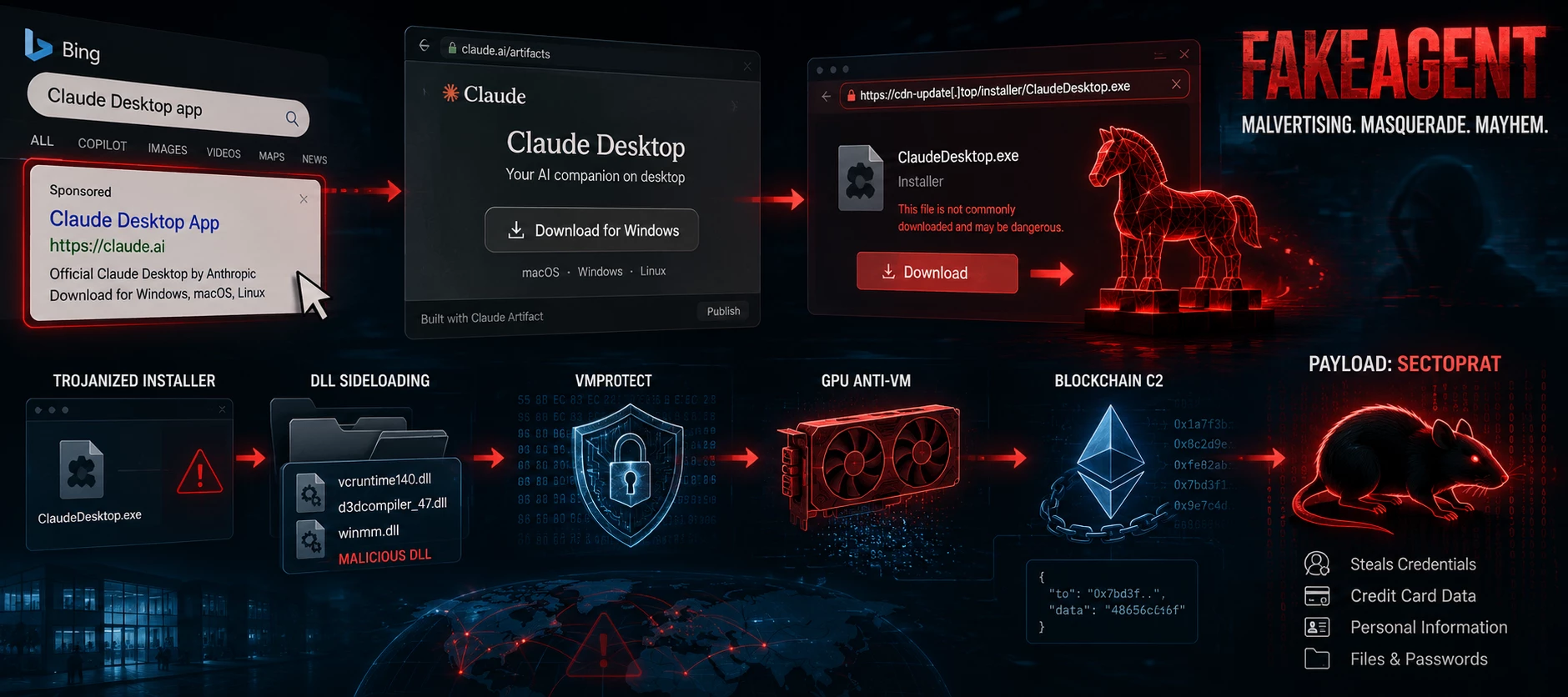
OverviewOn July 21-22, 2026, Huntress' Security Operations Center identified a burst of unusual executable installs, Microsoft Defender exclusions, and anomalous persistence activity across 29 separate organizations, all traced back to a single process name: ClaudeDesktop.exe. Huntress has named the campaign FakeAgent, and the investigation that followed is one of the more unusual malvertising cases of the year, both for its abuse of legitimate infrastructure and for the anti-analysis lengths the operator went to protect the payload.The short version: a Bing search ad for "Claude Desktop app" pointed, legitimately, to claude.ai. But the ad's destination was a user-generated Claude Artifact, a feature that lets anyone publish and share simple interactive content on Anthropic's own domain. The artifact impersonated the official Claude Desktop download page and redirected victims off-domain to attacker infrastructure serving a trojanized installer. What followed was a Matryoshka-doll chai
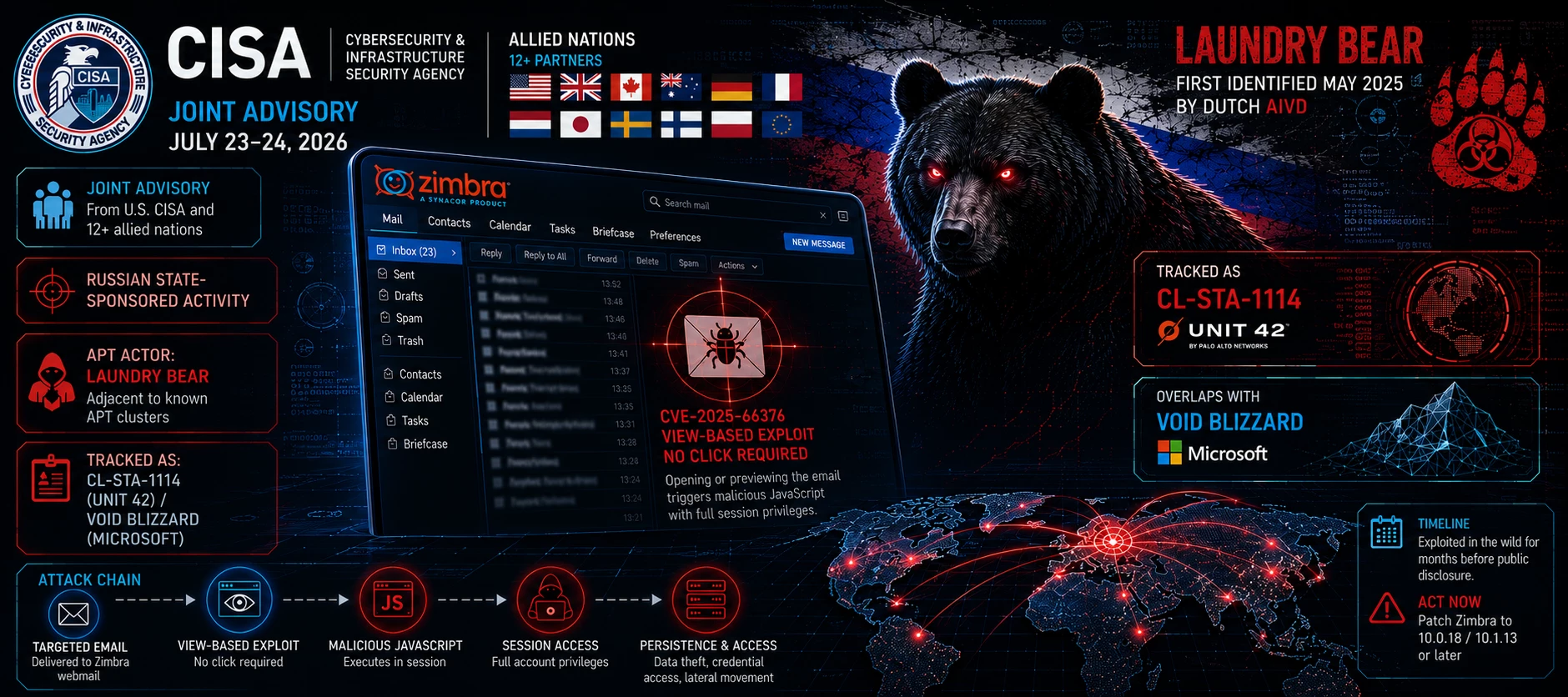
TL;DRA Russian state-sponsored actor (tracked by Unit 42 as CL-STA-1114, by the Dutch AIVD/MIVD and joint international advisory as "Laundry Bear," and overlapping with Microsoft's Void Blizzard) has been exploiting a Zimbra Collaboration Suite zero-day (CVE-2025-66376) since at least July 2025. The exploit is a "half-click"/zero-click stored XSS: simply opening or previewing a crafted HTML email in a vulnerable Zimbra Classic UI webmail session is enough to trigger silent JavaScript execution and full mailbox compromise: no attachment, no link click, no macro. The campaign is far larger than the single incident that first surfaced it. Seqrite Labs publicly documented one narrow slice in March 2026 (a Ukrainian State Hydrology Agency target, which it named "Operation GhostMail" and attributed with medium confidence to APT28/Fancy Bear). A July 2026 joint advisory from CISA and 14 other countries' agencies, corroborated by Unit 42 and Proofpoint, revealed the activity dates back a full
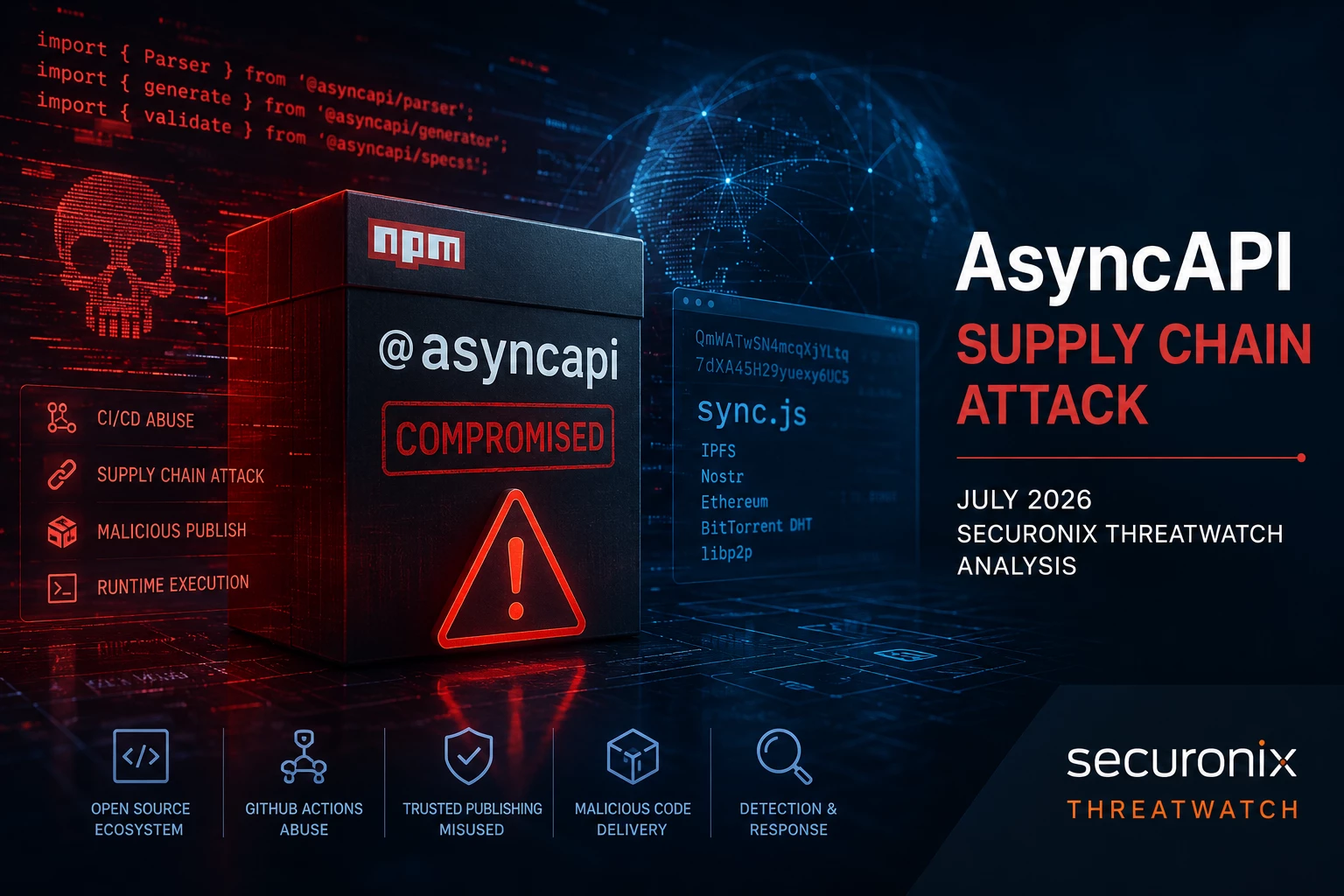
Executive Summary: Several packages in the @asyncapi npm namespace were maliciously republished after an attacker abused AsyncAPI's release process. The malicious code did not rely on npm lifecycle scripts. It executed when affected runtime modules were imported or required, which means npm install --ignore-scripts would not have prevented execution once a compromised package was loaded by an application, build process, or developer tool. The impact extended beyond the directly republished packages because @asyncapi/specs is used across AsyncAPI tooling. Parser-based validation, generators, CI jobs, container builds, and developer workstations may have been exposed if they resolved and loaded the affected versions during the publication window.The releases moved through legitimate publishing channels, including GitHub Actions OIDC trusted publishing and valid provenance attestations. Provenance confirmed the publishing path. It did not prove that the release content was safe. The secon
name: 'WordPress wp2shell Post-Exploitation Persistence and Enumeration Activity Analytic'signatureid: WAF-APP02-RUNcategory: 'Persistence'threatname: 'Server Software Component: Web Shell'functionality: 'Web Proxy'description: | Detects the post-exploitation web activity Wiz Research observed following successful exploitation of the wp2shell WordPress Core RCE chain (CVE-2026-63030 + CVE-2026-60137), disclosed 2026-07-17 and confirmed exploited in the wild from 2026-07-18. This rule covers what multiple actors did next on compromised, cloud-self-hosted WordPress instances: 1. Malicious plugin upload for persistence — attackers accessed /wp-admin/plugin-install.php?tab=upload and POSTed to /wp-admin/update.php?action=upload-plugin to install backdoors. Observed payloads included a minimal one-liner PHP webshell (eval($_POST['<param>'] ?? 'http_response_code(404);'), returning 404 as an evasion technique), a ~150KB full-featured webshell masquerading
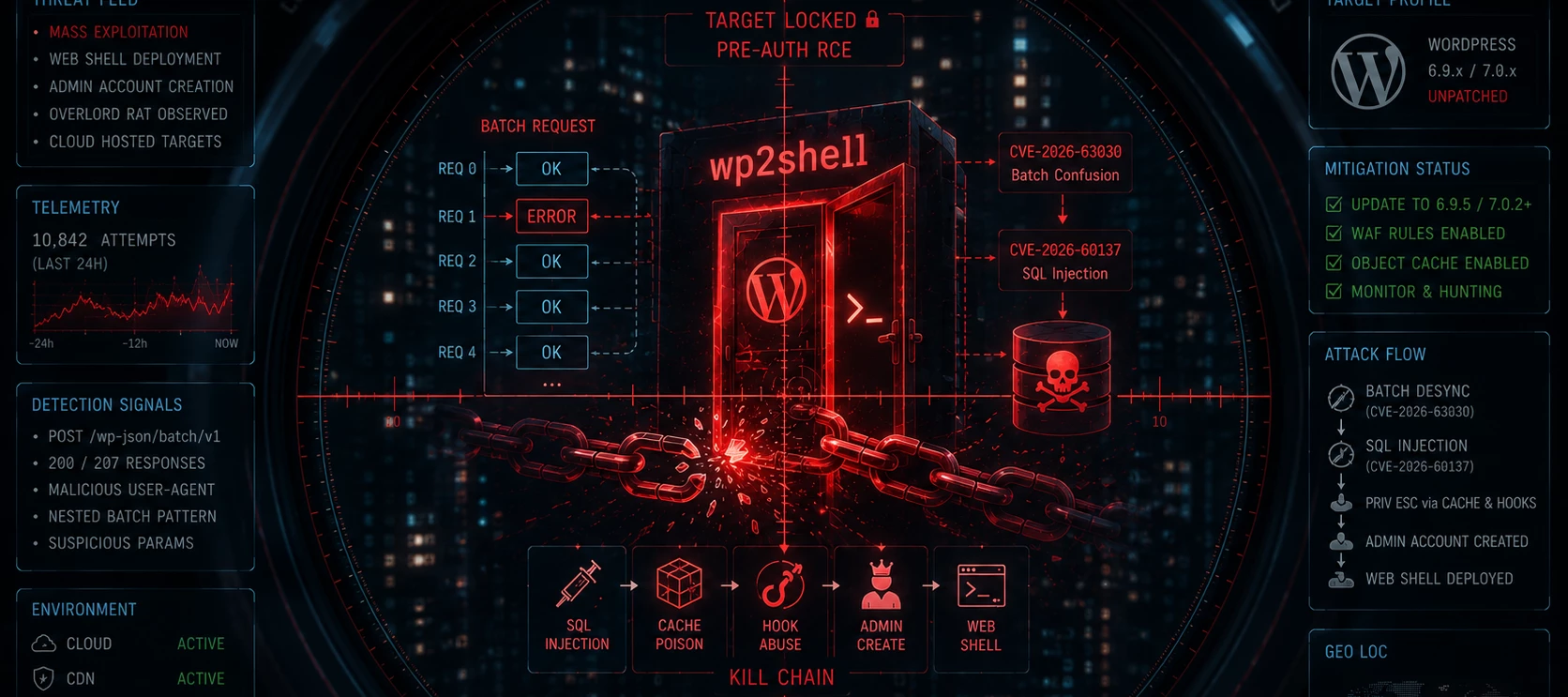
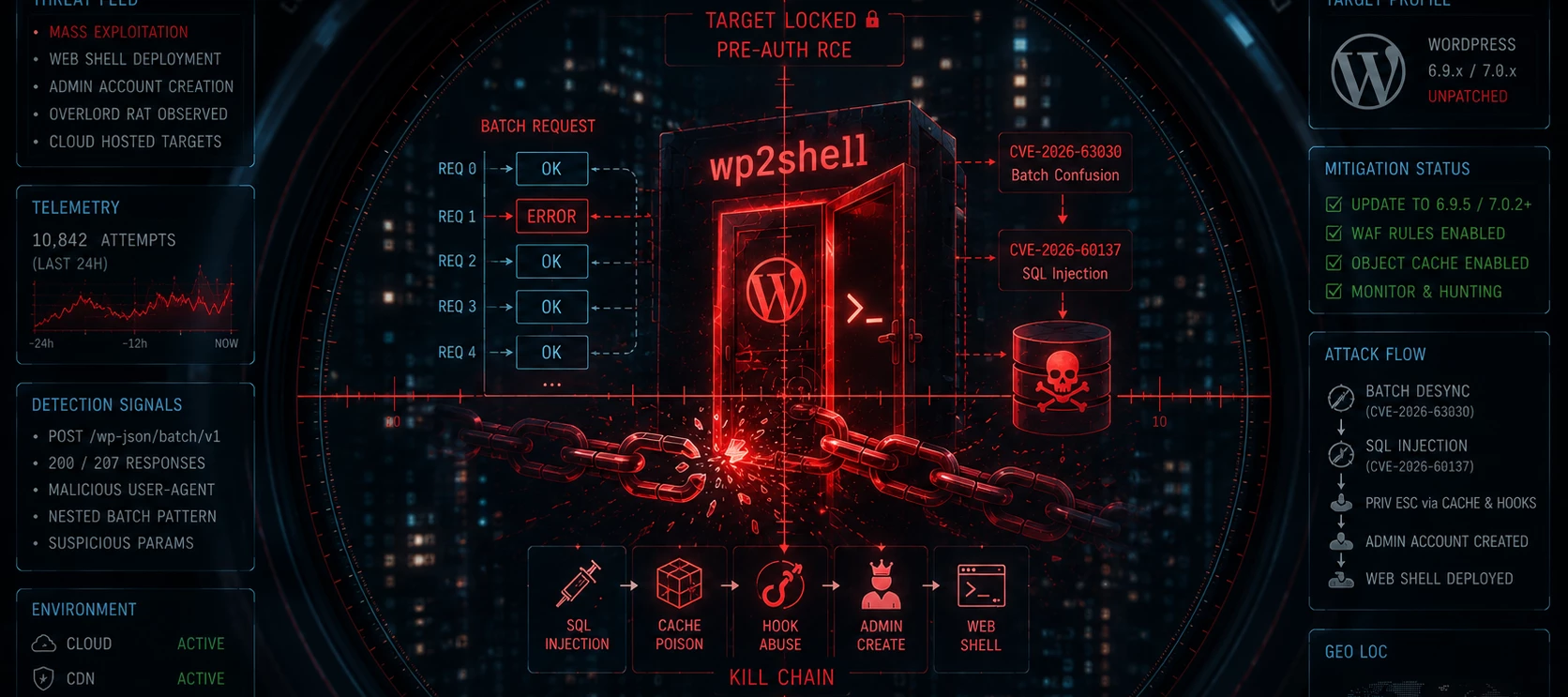
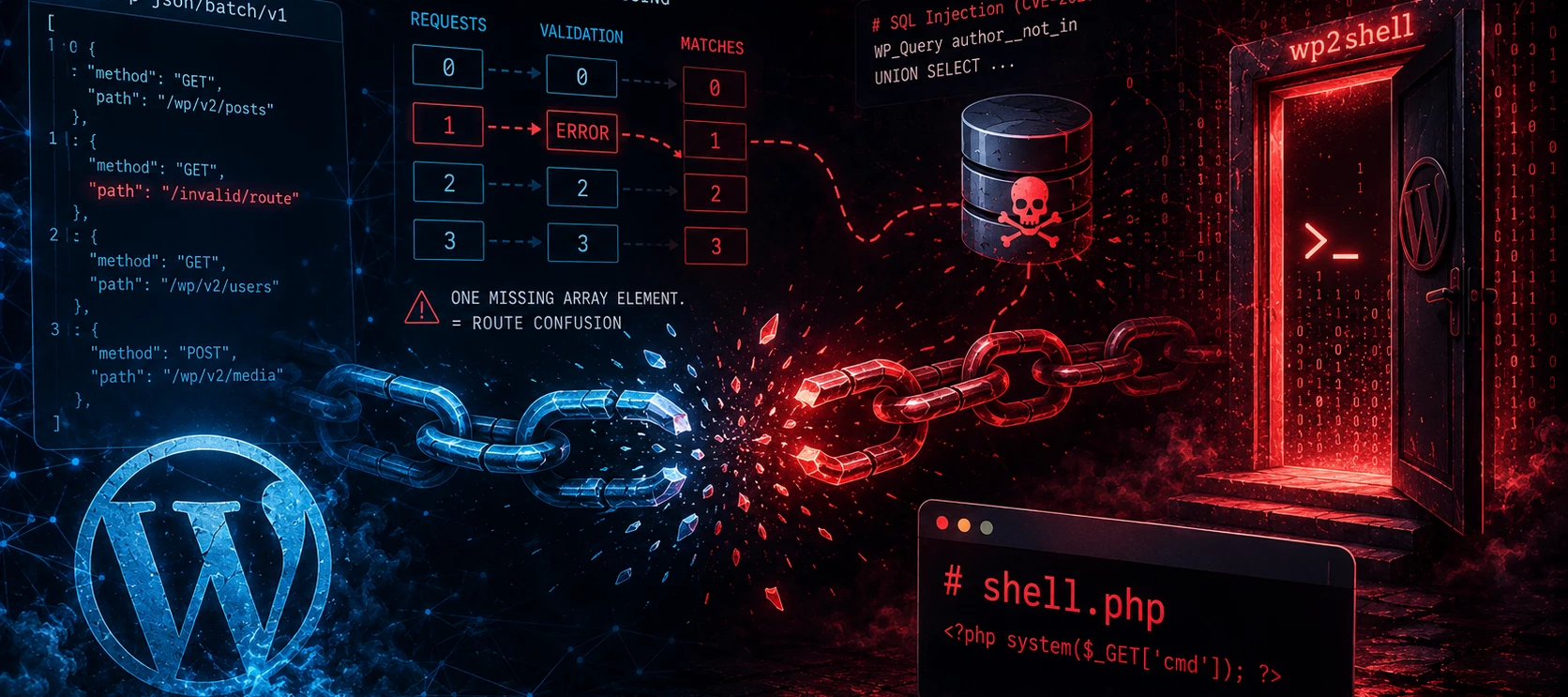
name: 'WordPress REST Batch API Exploitation wp2shell Analytic'signatureid: WAF-APP01-RUNcategory: 'Initial Access'threatname: 'Exploit Public-Facing Application'functionality: 'Web Application Firewall'description: | Detects requests to the WordPress Core REST API batch endpoint consistent with exploitation of "wp2shell", a pre-authentication remote code execution chain in WordPress Core disclosed 2026-07-17 and confirmed exploited in the wild from 2026-07-18. wp2shell chains CVE-2026-63030 (REST API batch-route confusion) with CVE-2026-60137 (SQL injection reached via the REST author_exclude parameter, which maps into WP_Query's author__not_in query variable). CVE-2026-63030 was discovered by Adam Kues of Searchlight Cyber / Assetnote; CVE-2026-60137 by researchers TF1T, dtro and haongo. Root cause: in WP_REST_Server::serve_batch_request_v1(), a sub-request that fails to parse is appended to the $validation array but not to $matches, leaving the two arrays off by one. Each di
OverviewOn July 17, 2026, WordPress shipped a coordinated security release closing a pre-authentication remote code execution chain reachable against a typical default install, no plugins required, no login page in front of it, provided a persistent object cache is not configured. WordPress runs roughly 43% of all websites. Searchlight Cyber, which found the primary bug, estimates over 500 million sites are built on it.The chain, named wp2shell, combines two flaws:CVE Description Vendor severity (WordPress GHSA) CVSSv3 (per Tenable / Hadrian) CVE-2026-63030 WordPress Core REST API batch-route confusion leading to RCE Critical 9.8, vector AV:N/AC:L/PR:N/UI:N/S:U/C:H/I:H/A:H published by Hadrian CVE-2026-60137 WordPress Core WP_Query author__not_in SQL injection Moderate 5.9 The WordPress GitHub Security Advisories carry severity labels only. The numeric scores and vector above come from third-party analysis (Tenable's RSO FAQ table and Hadrian's technical overview),
name: OTTERCOOKIE Stealer Upload to Rare DEV Domain via axios User-Agent Analyticsignatureid: PXY-WEB11-ERIcategory: 'Exfiltration'threatname: 'Exfiltration Over C2 Channel'functionality: 'Web Proxy'description: | Detects the credential, wallet, and file exfiltration HTTP behavior of the REF9403 Contagious Interview / OTTERCOOKIE stealer modules at the web-proxy layer, without depending on a specific C2 domain that is likely to be sinkholed or rotated shortly after publication. The browser credential / crypto wallet stealer and the file stealer both submit stolen data via HTTP POST to a /upload endpoint (multipart for browser artifacts, raw files for the file stealer) and, for wallet LevelDB stores, to a /cldbs endpoint. All stealer network requests are issued by the malware's embedded HTTP client using the distinctive User-Agent axios/1.18.1. Rather than pinning to rightwidth[.]dev, this rule matches the durable request signature (POST to /upload or /cldbs carrying the axios/
name: OTTERCOOKIE Clipboard Stealer High-Frequency Get-Clipboard Polling Analyticsignatureid: WEL-PSH136-RUNcategory: 'Collection'threatname: 'Clipboard Data'functionality: 'Microsoft Windows PowerShell'description: | Detects the Windows clipboard-stealer module of the REF9403 Contagious Interview / OTTERCOOKIE campaign. The malware's fourth module polls the clipboard every 500 milliseconds and exfiltrates any changed content to the rightwidth[.]dev C2. On Windows it retrieves clipboard contents by spawning a fresh PowerShell process for every poll using the exact invocation "powershell -NoProfile -NonInteractive Get-Clipboard" with windowsHide set. Because a new short-lived PowerShell process is created roughly twice per second, the behavioral signature is a high-frequency repetition of NoProfile/NonInteractive Get-Clipboard executions from the same host. This rule uses aggregated event analytics to surface that abnormal cadence, which is inconsistent with any legitimate inte
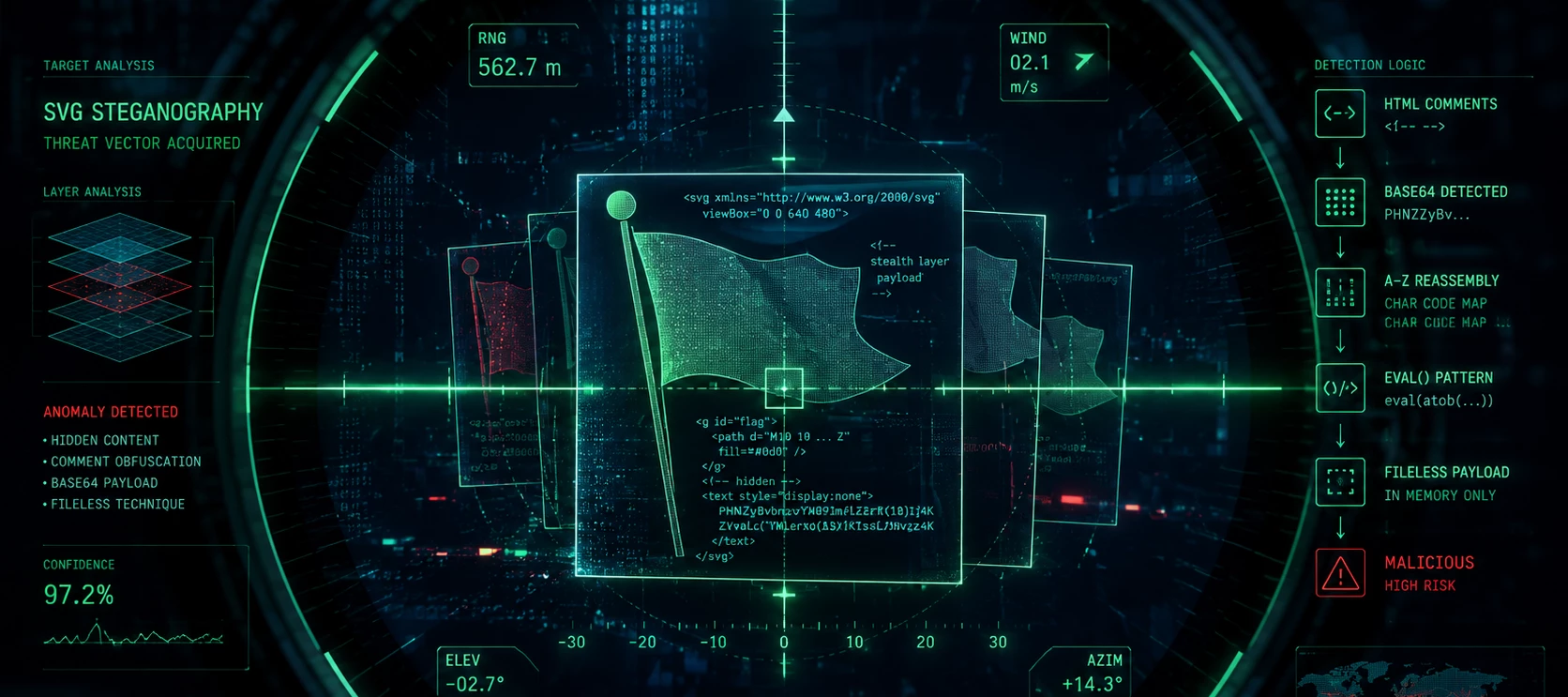
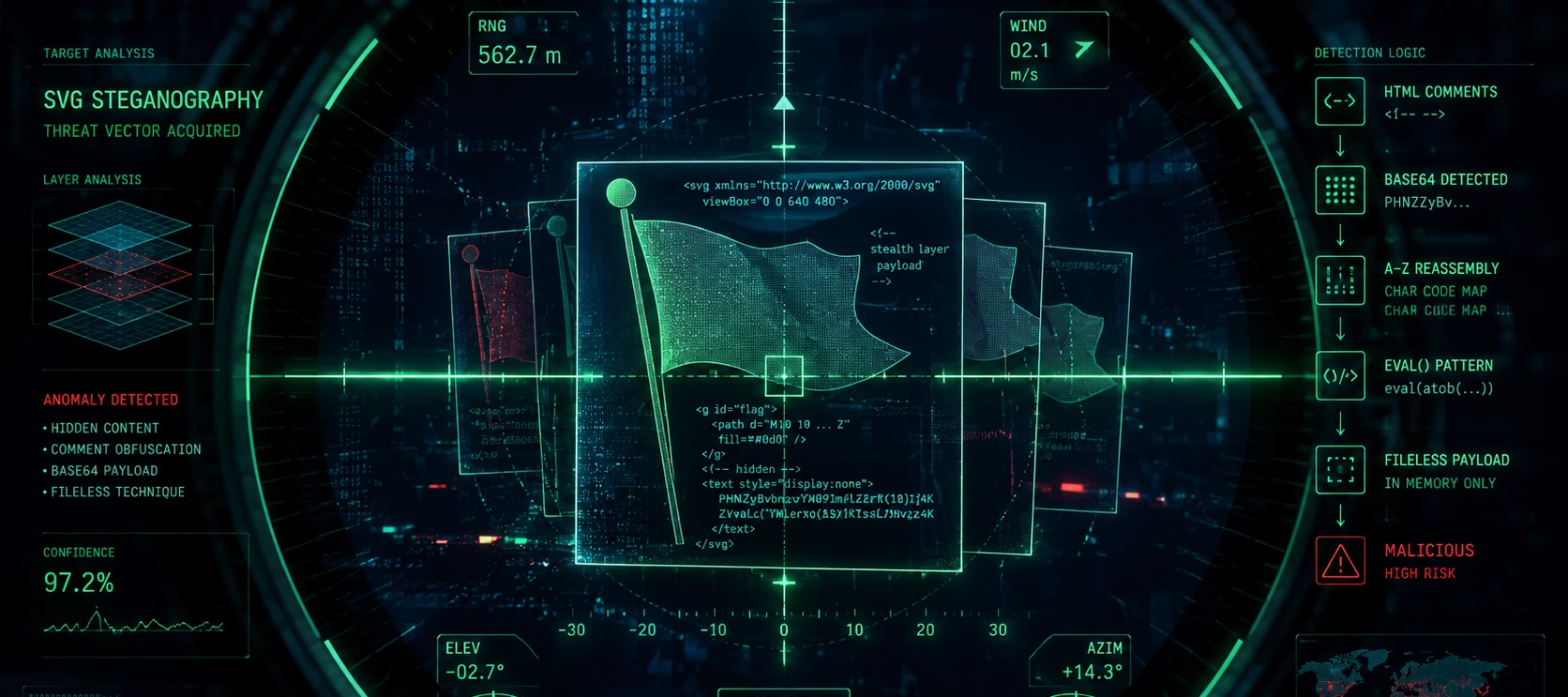
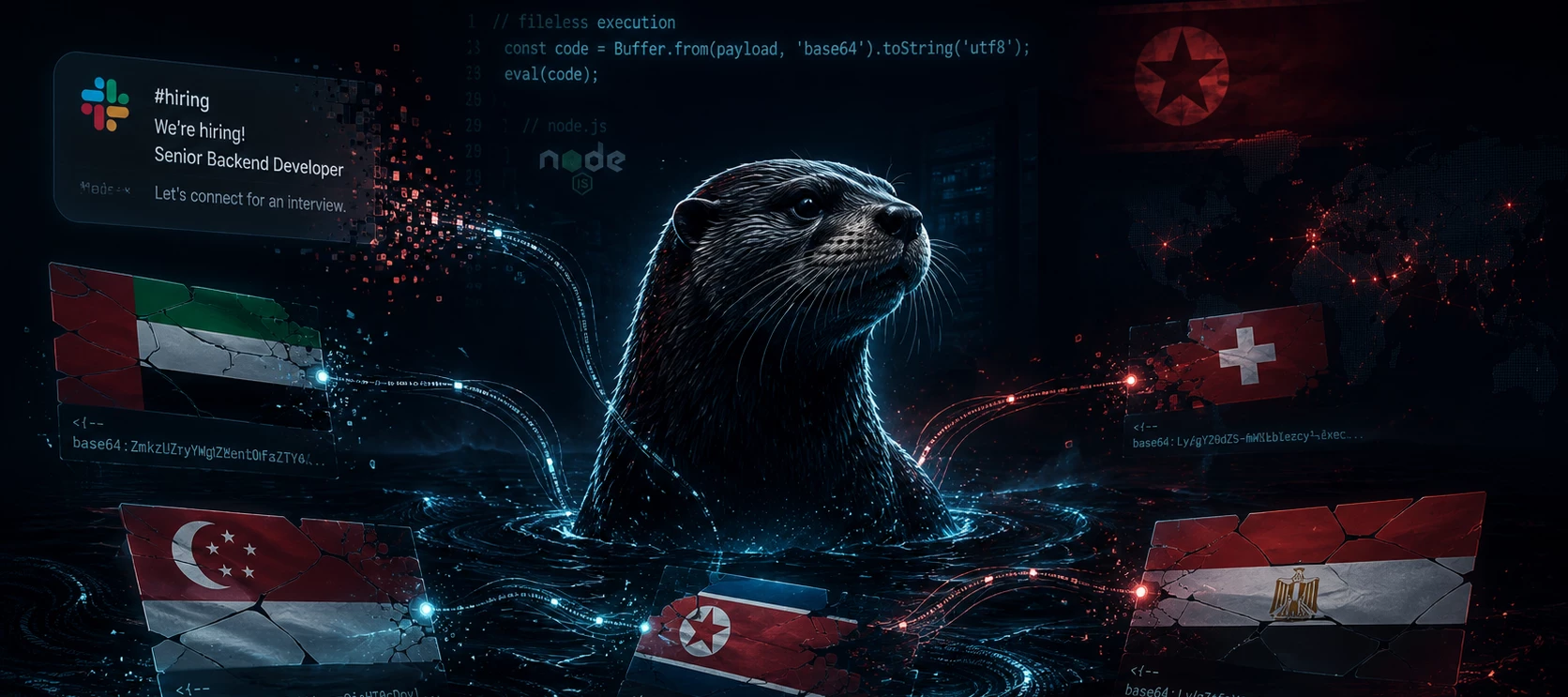
name: OTTERCOOKIE SVG Steganography Payload Reassembly and Eval Execution Analyticsignatureid: EDR-NIX26-RUNcategory: 'Execution'threatname: 'Command and Scripting Interpreter: JavaScript'functionality: 'Endpoint Management Systems'description: | Detects the SVG steganography reassembly and dynamic execution stage of the REF9403 Contagious Interview / OTTERCOOKIE campaign. DPRK-aligned actors distribute trojanized e-commerce "coding challenge" repositories (e.g. next-ecommerce-private-main, shopping-platform, gocart-based Next.js templates) in which the malware payload is split into Base64 fragments embedded inside HTML comment blocks (<!-- ... -->) across every country-flag SVG in an assets directory (AE.svg, AF.svg, etc.). A helper file (serverValidation.js) reads every .svg in the flags directory in alphabetical order, concatenates the comment-block chunks, decodes them with a custom Base64 function named Check(), and passes the result straight to eval() via runServer
OverviewOn May 26, 2026, a user calling themselves "Maxwell" posted in the #jobs channel of Elastic's public community Slack workspace, claiming to be upgrading an e-commerce platform to "a modern, scalable architecture using Next.js (v14), NestJS, PostgreSQL, and Auth.js" and looking for an experienced developer to help. Interested developers were moved into direct messages and asked to complete a take-home coding assessment -- a familiar Contagious Interview playbook that has been running since at least December 2022.What was not familiar was how the payload was hidden. Elastic Security Labs, which discovered the campaign after the actor targeted its own Slack community, found that the malicious code was split into Base64-encoded fragments and stashed inside HTML comments across every SVG "flag" image (AE.svg, AF.svg, and so on) bundled into the trojanized repository's assets directory. A helper script reassembled the fragments in alphabetical order and eval()'d the result on every s
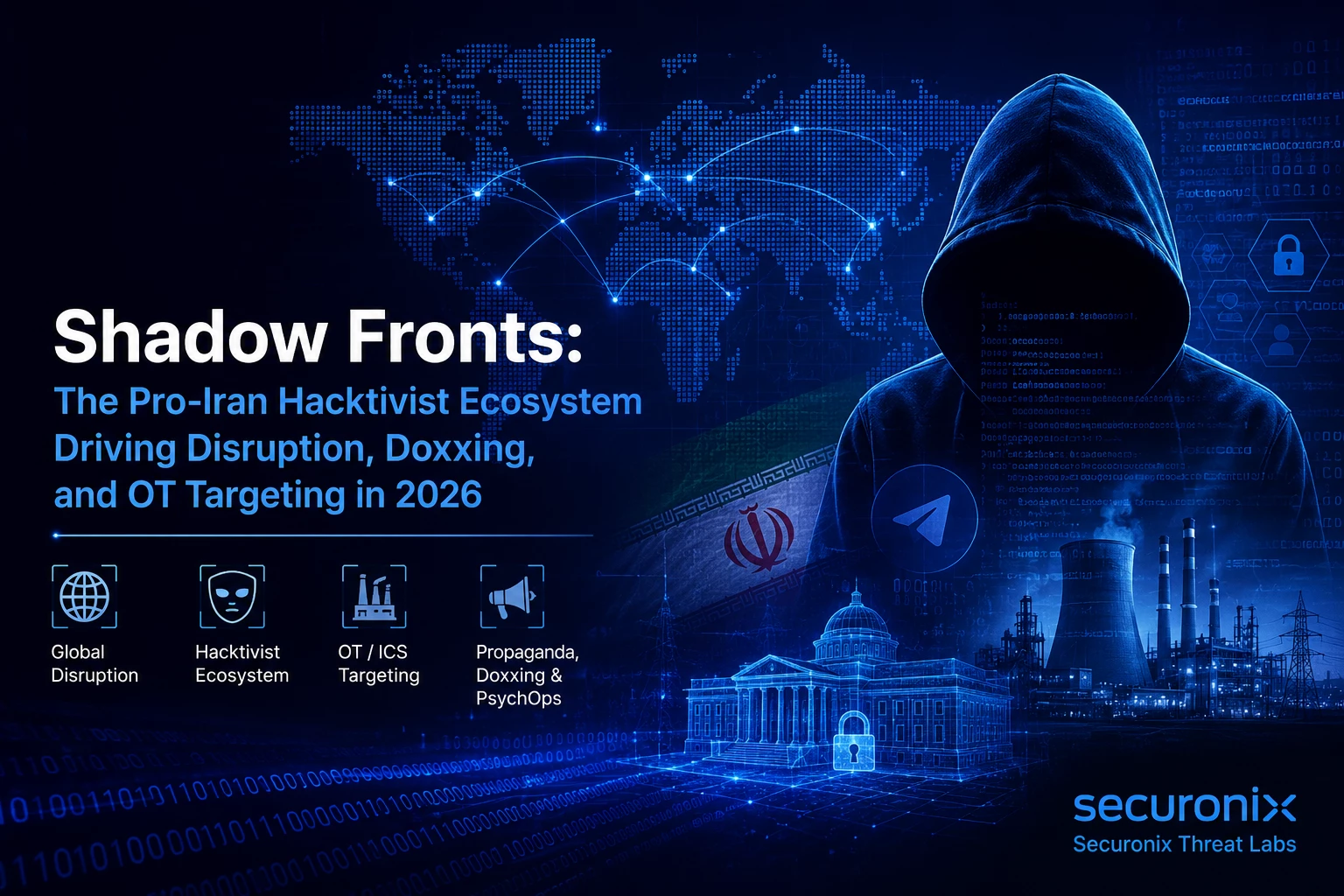
Executive summary: Pro-Iran hacktivist activity in 2026 is best understood as a decentralized Iran-aligned mobilization network. It combines state-linked personas, semi-deniable proxy brands, regional ideological teams, and foreign hacktivist participants. Most activity centers on DDoS, defacement, doxxing, hack-and-leak operations, and public intimidation. A smaller but more serious subset involves destructive tooling, OT (Operational Technology) and ICS (Industrial Control Systems) targeting, identity abuse, and cyber-enabled threats. The overall activity is noisy and uneven, but the risk is real: these actors mobilize quickly, amplify claims widely, and keep their narratives closely tied to Iranian geopolitical interests. Handala is the most consequential public-facing brand in this activity set. Securonix ThreatWatch team assesses Handala as the highest-priority brand in the 2026 Iran-aligned hacktivist ecosystem because of its links to the MOIS-associated cluster tracked as Void M
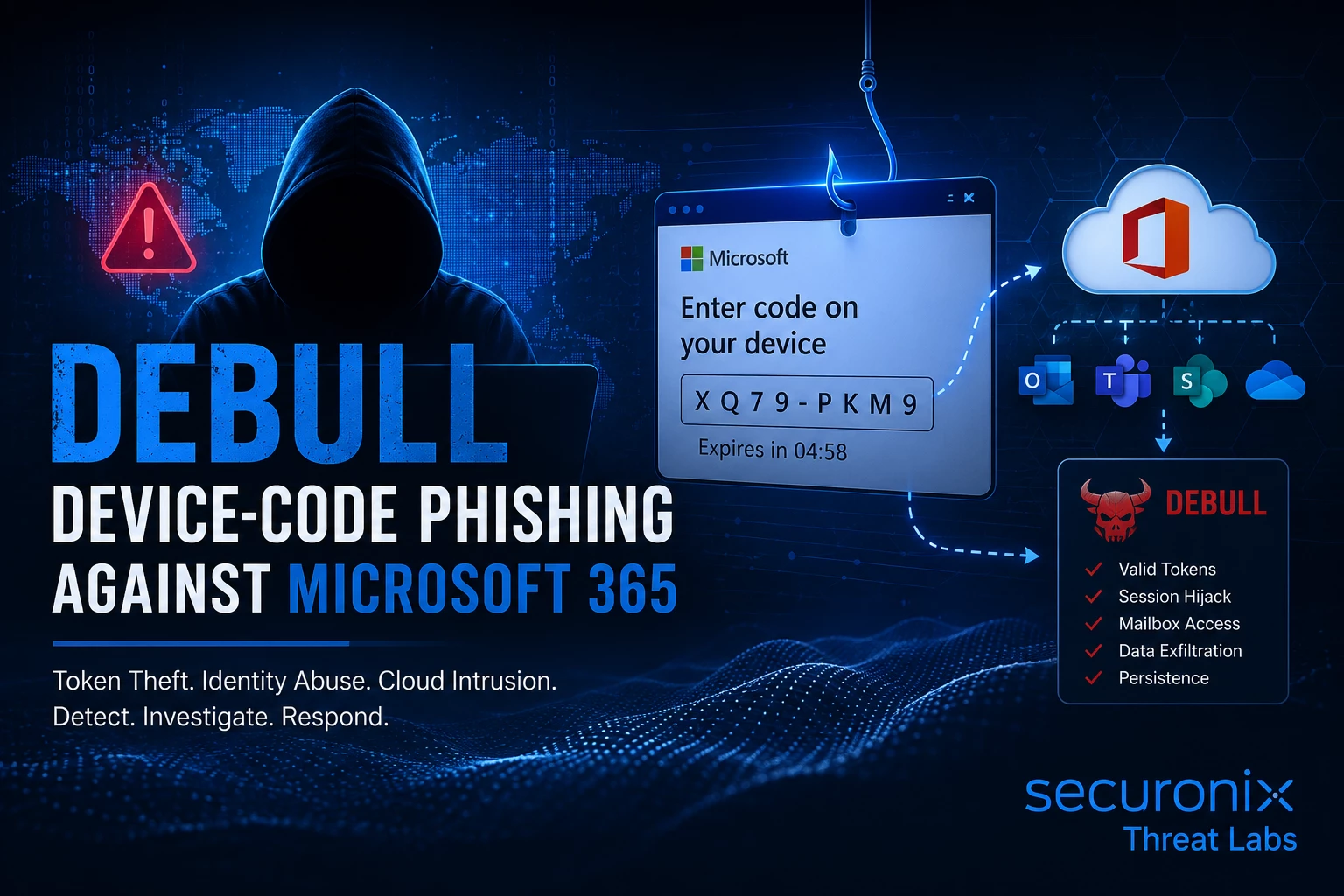
Executive summary:Reporting available through July 14, 2026 indicates that DEBULL is a reusable Microsoft 365 device-code phishing broker and operator platform rather than a single phishing page. During the late June to early July campaign, attackers used payment, shared-folder, and collaboration-themed lures to direct victims into Microsoft's legitimate device authentication flow. The DEBULL backend generated and polled device codes, allowing the operator to obtain valid OAuth tokens after the victim completed authentication and then reuse the authenticated session from attacker-controlled infrastructure. The same activity linked Microsoft Authentication Broker sign-ins to infrastructure hosting a DEBULL management panel and identified a post-authentication artifact named GraphSpy-Device. The observed tradecraft is consistent with Storm-2372-style device-code phishing, although there is no evidence attributing the activity to Storm-2372 itself. The primary objective is token theft rat
Authors: Nitish Singh, Nikhil Kumar Chadha, and Tanmay Kumar Introduction: The Monthly Intelligence Insights report provides a summary of top threats curated, monitored, and analyzed by Securonix Threat Labs in June 2026. The report also includes a synopsis of the threats, indicators of compromise (IoCs), tactics, techniques, and procedures (TTPs), and related tags. Each threat has a comprehensive summary from Threat Labs and search queries from the Threat Research team. For additional information on Threat Labs and related search queries used via Autonomous Threat Sweeper to detect the below-mentioned threats, refer to our Threat Labs home page.Last month, Securonix Autonomous Threat Sweeper identified and analyzed 4,566 TTPs and IoCs; identified 129 emerging threats; investigated 94 potential threats; and elevated 14 incidents. The top data sources swept against include IDS / IPS / UTM / Threat Detection, Data Loss Prevention, Endpoint Management Systems, and Email / Email Security.E
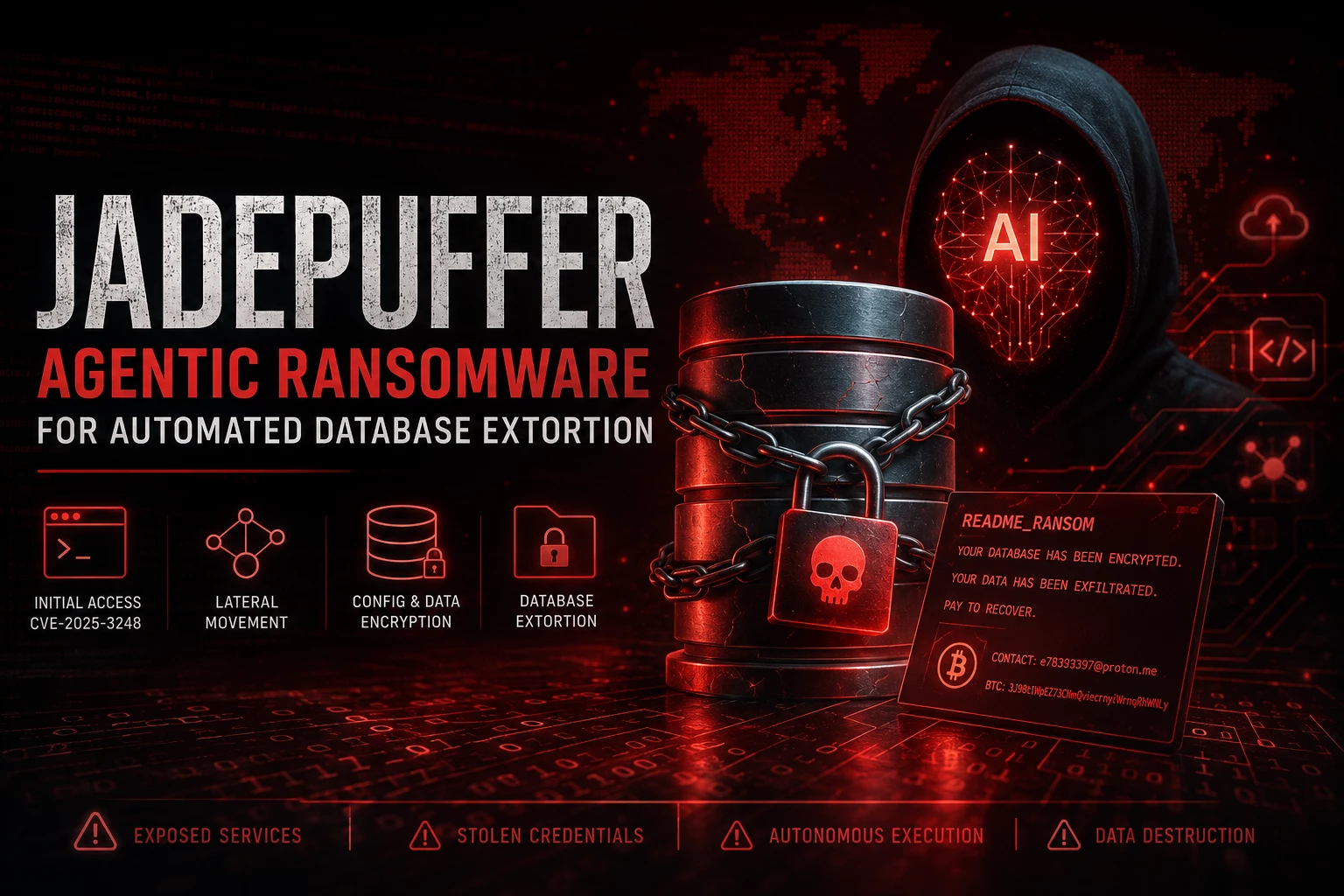
Executive summary: Sysdig Threat Research reporting from July 2026 describes JADEPUFFER as an extortion operation in which an LLM-based agent appears to have performed many tactical intrusion steps after initial access: host discovery, credential collection, object store access, movement toward internal services, persistence, configuration encryption, and destructive database activity. The chain did not depend on a new exploit path. It combined an internet-facing Langflow server vulnerable to CVE-2025-3248, secrets available to the compromised process, weak object-store controls, access to a configuration service, and administrative database privileges. NVD describes CVE-2025-3248 as remote, unauthenticated code execution in the /api/v1/validate/code endpoint in Langflow versions before 1.3.0. The main operational issue is speed. Agentic automation can test known weaknesses, adjust after failed steps, and move between connected services before normal triage or patch processes catch up.
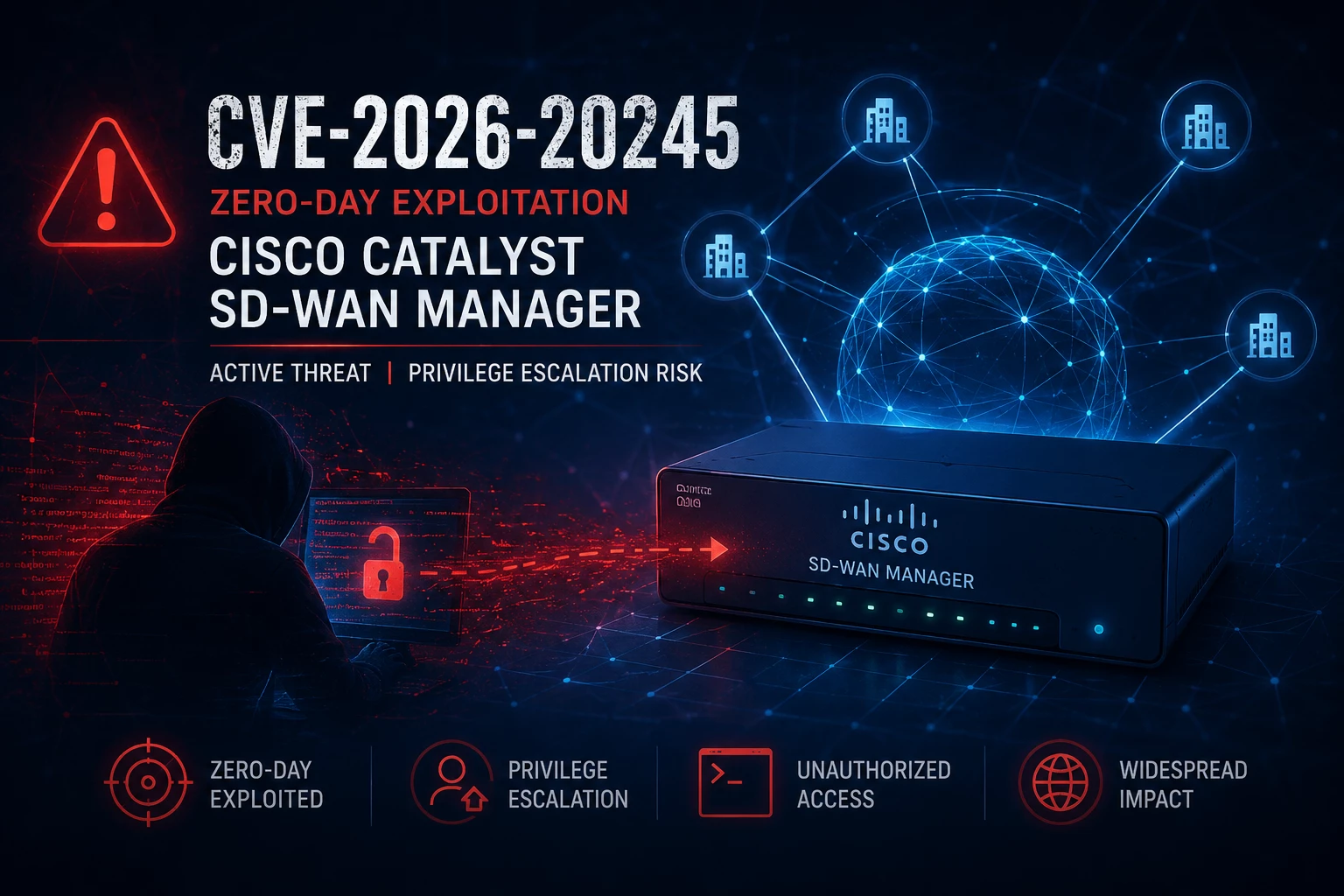
CVE-2026-20245 matters as a control plane compromise that can lead to root access on Cisco Catalyst SD-WAN control components. The issue affects the CLI in Cisco Catalyst SD-WAN Controller, Manager, and Validator, which were formerly known as vSmart, vManage, and vBond. Cisco describes it as an authenticated local privilege escalation. An attacker with netadmin privileges can submit a crafted file, trigger command injection, and run commands as root. That access requirement changes how the case should be read. In most cases, this is a second-stage issue rather than the first move. The attacker already needs a foothold, whether through valid credentials, compromised credentials, or an earlier SD-WAN authentication bypass weakness. Cisco has not described broad exploitation through other paths, but it has seen limited cases where attackers used this access to push configuration changes to edge devices. Prioritize systems exposed to untrusted management networks, the ones showing rogue pe
OverviewBetween March 30 and May 1, 2026, Cato CTRL researcher Vitaly Simonovich tracked a French-speaking cybercriminal known by the handle "Poisson" through every command of a 33-day intrusion operation. The result was 339 recorded commands, four compromised victims, and a persistence mechanism that continued functioning for 18 days after the attacker's primary command-and-control (C2) server went offline.What makes Operation Poisson stand out from the routine credential-theft campaigns that plague small businesses is not the sophistication of the attacker. Poisson is, by all available indicators, a junior operator -- likely a student learning offensive security while running live operations against real targets. What makes it notable is the specific persistence decision he made on Day 8: installing OpenSSH Server and Tailscale VPN on a victim machine to create a resilient access layer entirely independent of his C2 framework.That single move validated what defenders have theorized f
TL;DRThe Gentlemen (operators tracked by Microsoft as Storm-2697) is a Russian-speaking, financially motivated ransomware-as-a-service operation that emerged mid-2025 from a Qilin affiliate split; its distinguishing feature is that operators centrally build, maintain, and distribute a full EDR-killer suite anchored by the in-house GentleKiller framework (8+ BYOVD variants) directly to affiliates, lowering the bar for affiliate-led intrusions. GentleKiller and its companion third-party killers (HexKiller, ThrottleBlood, HavocKiller) all work via Bring Your Own Vulnerable Driver (BYOVD): drop a signed-but-vulnerable kernel driver, load it as a service, then send IOCTLs to terminate 400+ security processes mapped to 48 vendors, defeating user-mode tamper protection from Ring 0. The single best detection surface is kernel driver-load telemetry (Sysmon Event ID 6 / Event ID 7045 service install) plus the GentlemenCollection staging directory. FortiGate edge compromise (CVE-2024-55591) is th
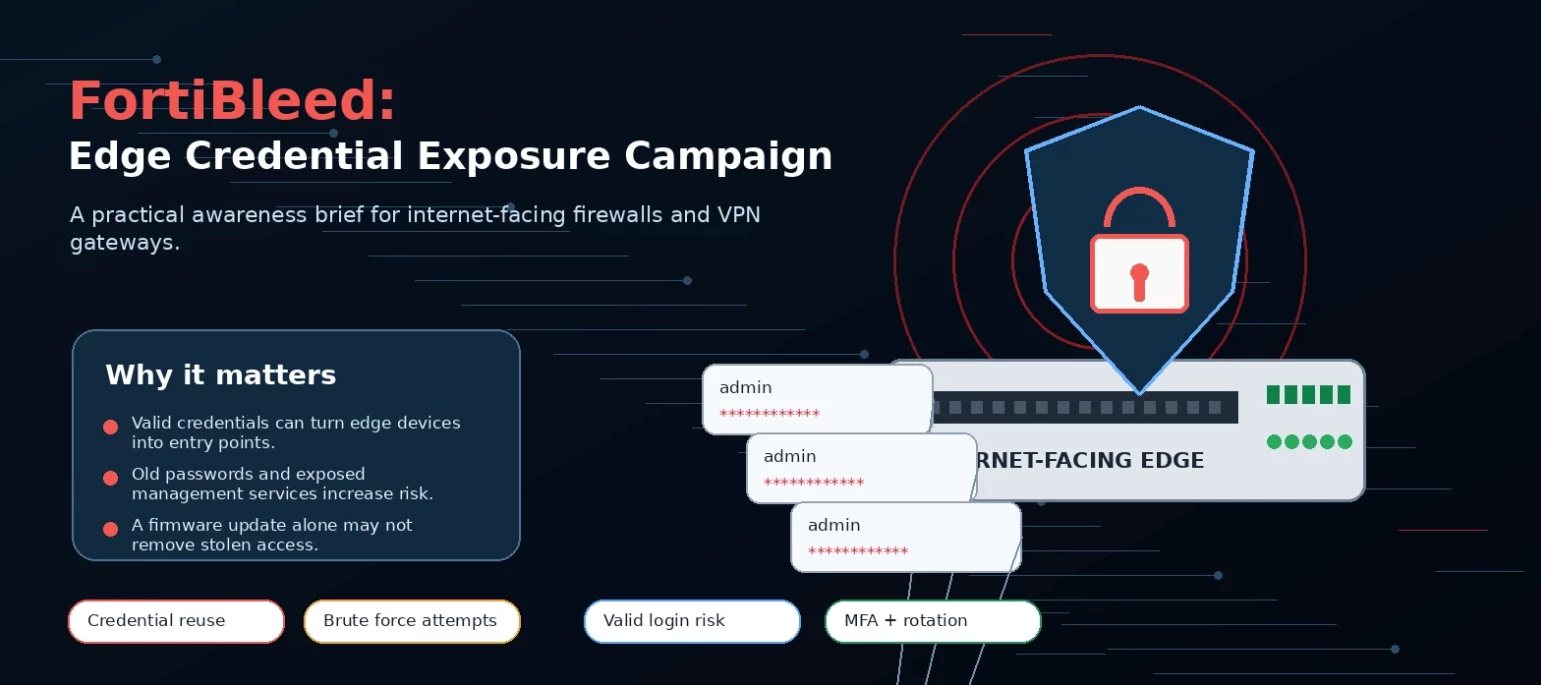
FortiBleed should be treated as an edge-credential exposure event. If a FortiGate administrator or SSL VPN account is valid and exposed, an attacker may not need a new exploit. They may be able to log in directly. Public reporting describes a credential-harvesting campaign involving Fortinet FortiGate firewalls, SSL VPN gateways, and administrative management interfaces. Researchers reported tens of thousands of device entries, including URLs, usernames, email addresses, plaintext passwords, and credential material tied to FortiGate environments. Fortinet's June 19 analysis says its initial review points to credential reuse from earlier incidents and brute-force activity against systems with weak password hygiene and no MFA. Fortinet says the activity is not tied to a new Fortinet vulnerability or a recent advisory. Current confidence Medium. Public reporting and Fortinet analysis agree that exposed or reusable credentials are the central issue. They differ on scale, collec
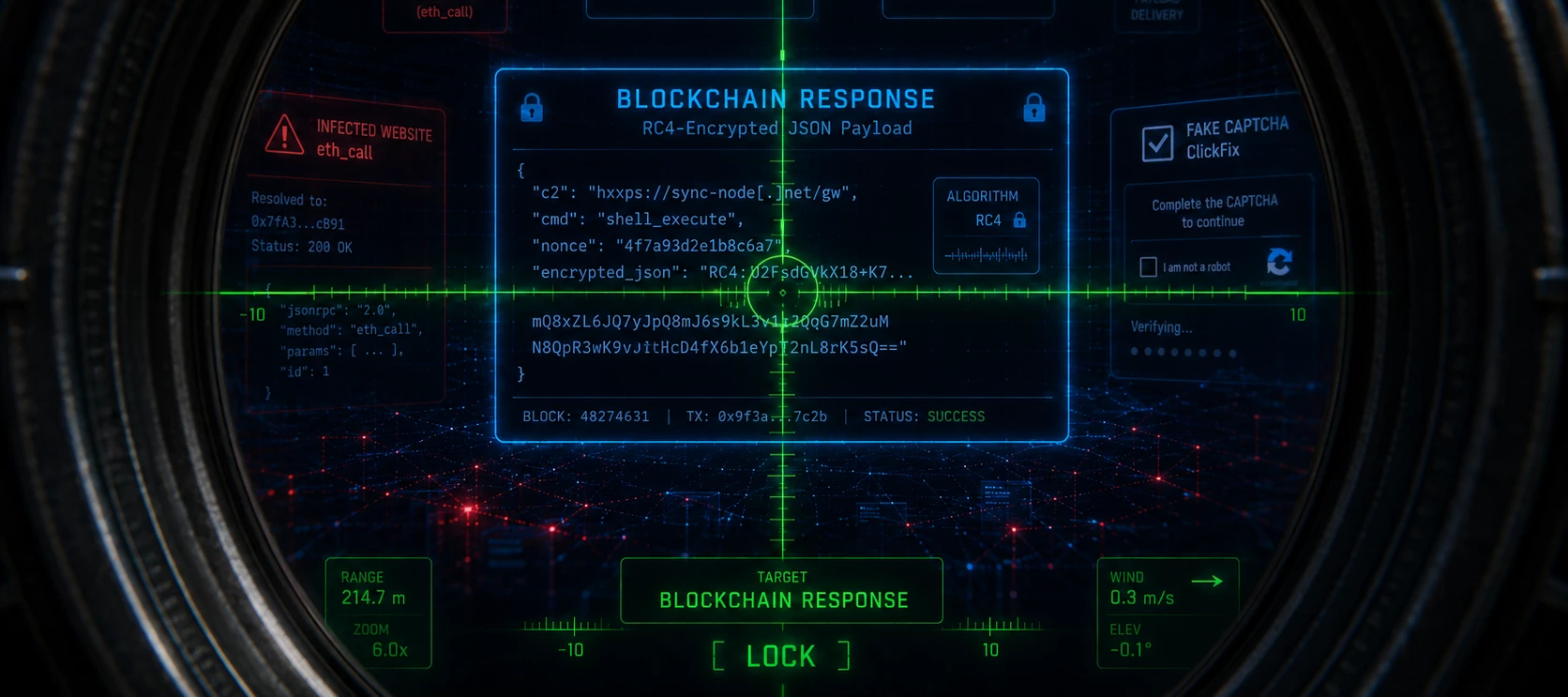
name: ErrTraffic ClickFix C2 API Endpoint Pattern Analyticsignatureid: PXY-WEB10-RUNcategory: 'Command and Control'threatname: 'Application Layer Protocol: Web Protocols'functionality: 'Web Proxy'description: | Detects outbound HTTP requests matching the distinctive C2 API endpoint patterns used by the two identified ErrTraffic ClickFix framework clusters ("Analytics" and "Beer"), as documented by Sekoia TDR. The "Analytics" cluster fetches its ClickFix lure script from a /cf.js endpoint after resolving its C2 via a single stable Polygon smart contract. The "Beer" cluster instead queries /api/index.php with a distinctive parameter set (a=ctx, os=, src=cloudflare, mode= download) to retrieve an RC4-encrypted PowerShell command, or loads its injector via /api/css.js. These endpoint and parameter patterns are independent of the current C2 domain, which both clusters rotate frequently via EtherHiding, making this a more durable signature than domain-based blocking alone.reference:
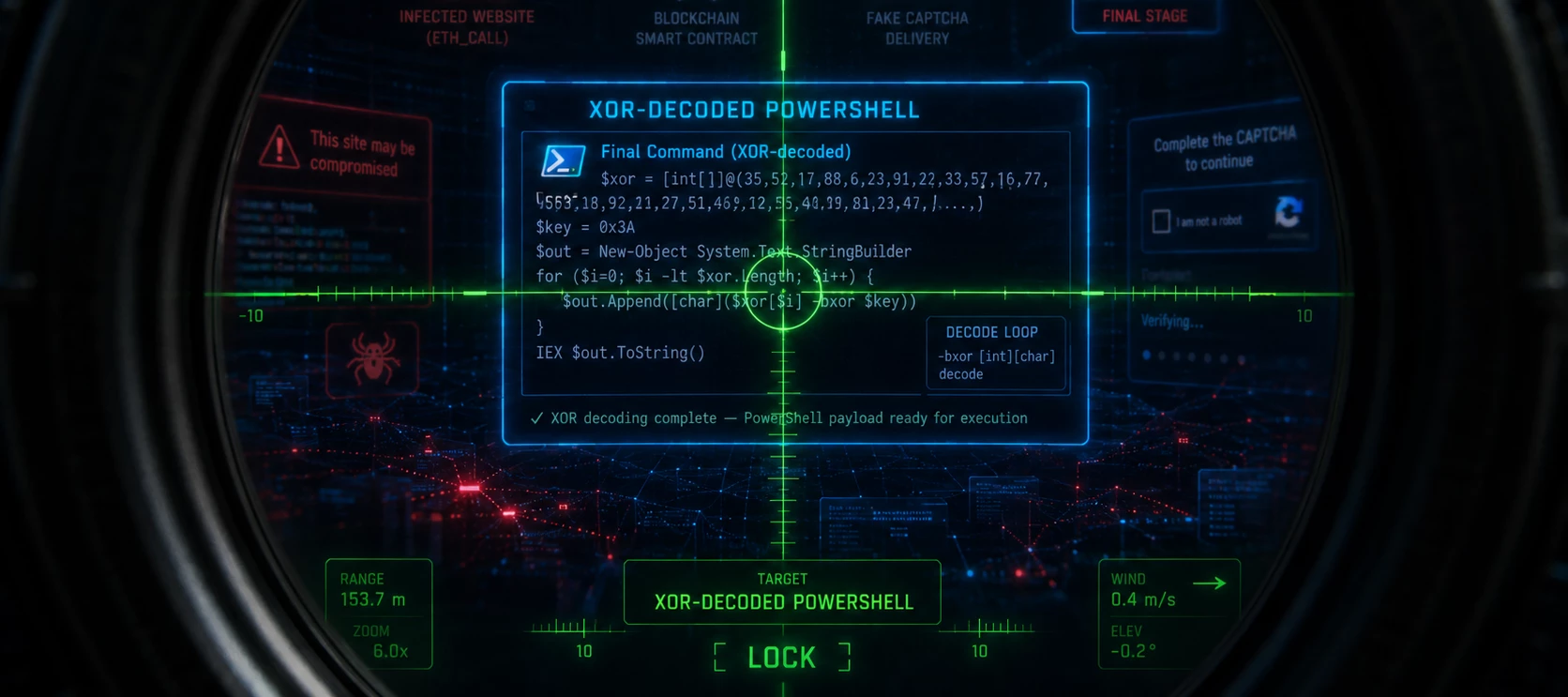
name: ErrTraffic ClickFix XOR-Decoded PowerShell Dropper Analyticsignatureid: WEL-PSH135-RUNcategory: 'Defense Evasion'threatname: 'Obfuscated Files or Information: Command Obfuscation'functionality: 'Microsoft Windows Powershell'description: | Detects the distinctive XOR-decode-and-execute PowerShell pattern used by the ErrTraffic ClickFix distribution framework to deobfuscate and run its dropper stage. ErrTraffic is a Malware-as-a-Service ClickFix toolkit (operator alias "LenAI") that, since its v3 release, uses the EtherHiding technique (Polygon and BNB Smart Chain smart contracts) as a dead-drop resolver to fetch C2 infrastructure and ClickFix lure content. After the victim is socially engineered into pasting a "verification" command into Run or PowerShell, the resulting PowerShell command line contains a Base64/character-code XORed string that is decoded inline using bxor against [int][char] values before being invoked. This decode pattern is distinct from generic obfusca
Already have an account? Login
Enter your E-mail address. We'll send you an e-mail with instructions to reset your password.