Share your knowledge, tips, and best practices. Showcase what you’ve built, learn from others, and inspire the community with your success stories.
Recently active
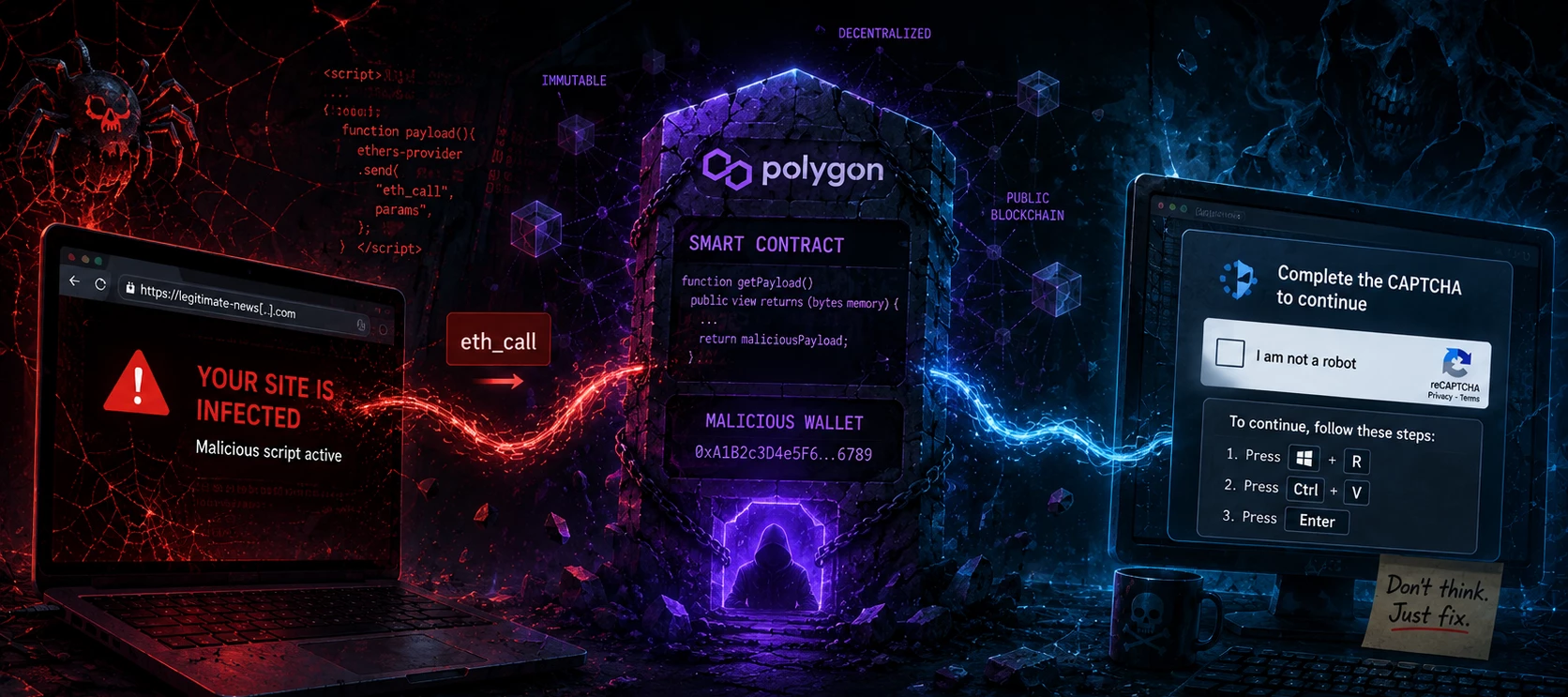
There's a particular kind of dread that sets in when two well understood attacker techniques, each individually annoying but manageable, get packaged together into a single commercial product. That's exactly what's happened with ErrTraffic, a Malware as a Service (MaaS) framework that has spent the past several months quietly fusing the EtherHiding technique with the ClickFix social engineering tactic into one rentable toolkit.Neither technique is new on its own. What's new is that they're now sold together, supported by a vendor, and actively iterated on based on customer feedback, the same way any other SaaS product evolves.The product, not the payloadErrTraffic first surfaced on Russian language cybercrime forums in December 2025, advertised by a threat actor operating under the handle LenAI. It wasn't pitched as malware. It was pitched as infrastructure: a Traffic Distribution System (TDS) that other criminals could rent to deliver whatever payload they wanted.The pitch was specifi
Authors: Dheeraj Kumar IntroductionThe Monthly Intelligence Insights report provides a summary of top threats curated, monitored, and analyzed by Securonix Threat Labs in May 2026. The report also includes a synopsis of the threats, indicators of compromise (IoCs), tactics, techniques, and procedures (TTPs), and related tags. Each threat has a comprehensive summary from Threat Labs and search queries from the Threat Research team. For additional information on Threat Labs and related search queries used via Autonomous Threat Sweeper to detect the below-mentioned threats, refer to our Threat Labs home page. Last month, Securonix Autonomous Threat Sweeper identified and analyzed 4,188 TTPs and IoCs; identified 113 emerging threats; investigated 81 potential threats; and elevated 19 incidents. The top data sources swept against include IDS / IPS / UTM / Threat Detection, Data Loss Prevention, Endpoint Management Systems, and Email / Email Security. Executive Summary TAX#TRIDENT: Fake In
name: Suspicious WMI QoS Policy Instance Creation Targeting Security Processes Analyticsignatureid: EDR-SYM933-RUNcategory: 'Defense Evasion'threatname: 'Impair Defenses: Disable or Modify Tools'functionality: 'Endpoint Management Systems'description: | Detects process-level WMI activity consistent with programmatic creation of MSFT_NetQosPolicySettingData instances in ROOT\StandardCimv2, the mechanism used by the EDRChoker compiled binary to apply QoS bandwidth throttle policies against EDR agent processes without invoking PowerShell. EDRChoker uses System.Management (WMI) directly from a C# binary to call ManagementClass.CreateInstance() and Put(PutType.CreateOnly) on MSFT_NetQosPolicySettingData, setting ThrottleRateAction to 8 bits per second against a target EDR process via AppPathNameMatchCondition. This approach bypasses Script Block Logging entirely and is not captured by WEL-PSH130-RUN. Detection relies on Sysmon Event ID 19/20/21 (WMI activity) or equivalent WMI ope
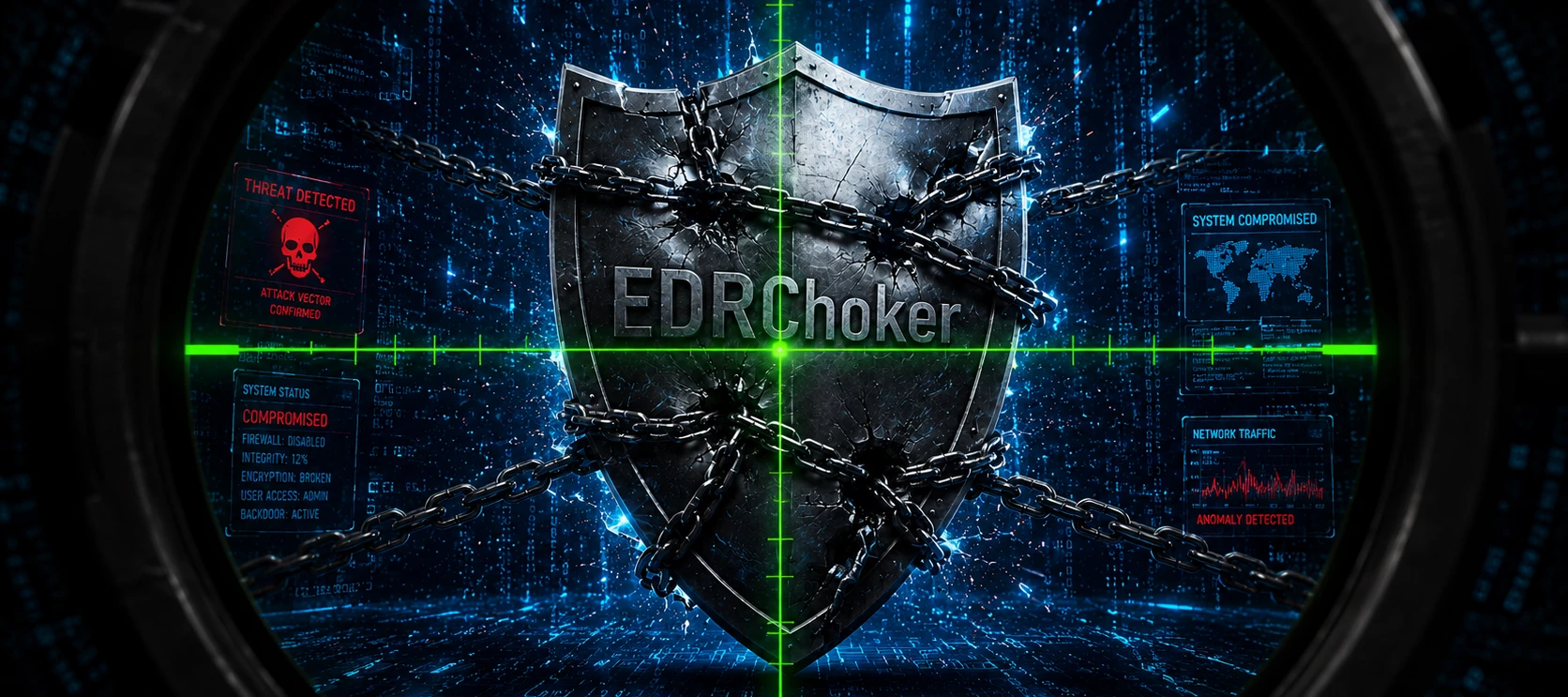
https://share.synthesia.io/edb6d139-f545-4254-a959-f2fd4ad90c95Published: June 10, 2026Tags: Defense Evasion, EDR Bypass, Red Team, T1562.001, Windows InternalsIntroductionFor years, the conversation around EDR bypass has centered on one of two approaches: kill the agent process outright, or cut its network access. Tools in both categories have matured significantly, and defenders have responded with increasingly robust detections. Firewall-based blocks leave packet-drop artifacts. BYOVD attacks require dropping a kernel driver to disk. Neither approach is quiet anymore.On June 7, 2026, a researcher publishing under the handle @TwoSevenOneT released a tool called EDRChoker that takes a different path entirely. Rather than killing or blocking an EDR agent, EDRChoker starves it. By applying extreme bandwidth throttling at a layer of the Windows network stack that most EDR solutions have never monitored, it causes agents to time out silently and continuously, severing their connection to
name: Suspicious Developer Secret Access via Node.js Ecosystem Analyticsignatureid: EDR-SYM931-RUNcategory: 'Credential Access'threatname: 'Unsecured Credentials'functionality: 'Endpoint Management Systems'description: | Detects Node.js ecosystem processes accessing sensitive developer, cloud, container, and infrastructure credential files. This behavior is commonly associated with malicious npm packages abusing lifecycle hooks such as preinstall, install, postinstall, or prepare scripts to harvest secrets from developer workstations. Threat actors increasingly target software supply chains by embedding credential-stealing functionality into npm packages. During execution, malicious Node.js code may enumerate SSH keys, cloud provider credentials, Kubernetes configurations, Docker authentication files, package manager tokens, Terraform state files, and Vault secrets before exfiltrating them to attacker-controlled infrastructure. Similar techniques wer
Published: June 4, 2026Tags: Supply Chain, npm, Credential Theft, CI/CD Security, T1195.002IntroductionOn June 1, 2026, a credential-stealing worm quietly embedded itself into 32 officially published packages under Red Hat's @redhat-cloud-services npm namespace. By the time security researchers noticed and began pulling malicious versions, those packages had already accumulated roughly 80,000 weekly downloads across 96 poisoned versions. By June 3, a second wave had spread the same worm to 57 more packages across entirely separate maintainer ecosystems, including the official Vapi.ai server SDK with over 408,000 monthly downloads.The campaign has been named Miasma, after a string the malware stamps onto attacker-created GitHub repositories: "Miasma: The Spreading Blight." The name fits. This is not a targeted intrusion against a single organization. It is a self-replicating supply chain worm, and the infection vector was not a zero-day or a clever bypass. It was a session cookie stolen
Published: June 2026Severity: CVSS 6.8 (Important) | Physical Access RequiredAffected Platforms: Windows 11 24H2, 25H2, 26H1 (x64) | Windows Server 2025 | Windows Server 2025 Server CorePatch Status: No patch available. Mitigation script released May 21, 2026.What Is YellowKey?YellowKey is a publicly disclosed zero-day vulnerability in Microsoft Windows that allows an attacker with brief physical access to a device to completely bypass BitLocker drive encryption and gain a SYSTEM-level command shell with full access to the protected volume. No password, recovery key, or specialized hardware is required. The attack takes approximately 60 seconds and uses a standard USB drive.The vulnerability was disclosed on May 12, 2026, by a security researcher operating under the names Chaotic Eclipse and Nightmare-Eclipse, reportedly out of frustration with Microsoft's handling of bug reports. Microsoft subsequently assigned CVE-2026-45585 to the issue and released an interim mitigation, while a fu
name: Netlogon Service Anomalous Restart or RPC from Non-DC Source Analyticsignatureid: WEL-SYS01-ERIcategory: 'Initial Access'threatname: 'Exploit Public-Facing Application'functionality: 'Microsoft Windows'description: | Detects the Netlogon service (NETLOGON) unexpectedly stopping or restarting — a key indicator of CVE-2026-41089 post-crash recovery — using event rarity on the source account to surface non-standard service control activity. Netlogon restarts are normal after planned reboots but rare in steady-state operation. Combined with the pre-auth nature of CVE-2026-41089, any unexpected Netlogon stop/start cycle should be investigated for preceding CLDAP anomalies. Also covers Service Control Manager events recording Netlogon termination with unexpected exit codes, which can indicate LSASS-driven shutdown cascade following stack corruption.reference: - https://msrc.microsoft.com/update-guide/vulnerability/CVE-2026-41089 - https://www.helpnetsecurity.com/2026/06/01/win
name: LSASS Crash on Domain Controller Potentially Related to Netlogon Analyticsignatureid: WEL-APP01-RUNcategory: 'Impact'threatname: 'Network Denial of Service'functionality: 'Microsoft Windows'description: | Detects LSASS application crashes on Windows domain controllers, specifically those referencing netlogon.dll as the faulting module. This is the primary host-side indicator of CVE-2026-41089 exploitation — a single malformed CLDAP UDP packet to port 389 causes a stack buffer overflow in BuildSamLogonResponse, corrupting the LSASS stack and triggering a fatal exception (0xC0000409 STATUS_STACK_BUFFER_OVERRUN). The domain controller reboots approximately 60 seconds after the crash. Repeated LSASS crashes in a short timeframe from the same host without a corresponding patch event strongly suggest active exploitation or automated scanning. Even a single occurrence on a DC warrants investigation given the pre-authentication, zero-interaction nature of the vulnerability.refer
Windows Netlogon CLDAP Stack Buffer Overflow RCEPublished: June 3, 2026 Severity: Critical | CVSS 3.1: 9.8 Status: Actively Exploited in the WildWhat Is It?CVE-2026-41089 is a pre-authentication, zero-interaction stack-based buffer overflow in the Windows Netlogon service affecting all Windows Server versions acting as Active Directory domain controllers. The vulnerability was patched by Microsoft on May 12, 2026 as part of Patch Tuesday, but as of May 29 the Centre for Cybersecurity Belgium (CCB) confirmed active exploitation in the wild. A public proof-of-concept is available on GitHub, and AI-assisted patch diffing is accelerating the timeline from patch release to weaponized exploit.A successful attack on a domain controller is not just a server compromise. It is a domain-wide compromise with a fast path to forest-level takeover.How Does It Work?The vulnerability lives in netlogon.dll inside a helper function called NetpLogonPutUnicodeString. When a domain controller receives a CLD
Did you know SAM understands Diamond Model Analysis? You can ask Sam to create a report on a violation, something that usually takes a LOT of time to do manually. While working a Violation, Ask Sam: Please prepare a diamond model analysisorFor this incident, build a Diamond Model. Identify the Adversary, Infrastructure, Capability, and Victim — and map any observed TTPs to each vertex. And you will get back a comprehensive report like below - you can of course fine tune your prompt for verbosity and content. What are your favorite SAM questions? Please share!
Did you know SAM can map a violation against MITRE? Simply ask: Map every alert in this incident to a MITRE ATT&CK technique and sub-technique. Then tell me which tactic phase is most heavily represented and what that implies about attacker intent.And SAM will produce an analysis for you like below What have you used SAM to do? Did it save you time?
Did you know Sam can create an exhaustive cyber kill chain analysis for an incident for you? You can use the prompt below to kick it off - and then of course continue the conversation. Walk me through which stages of the Cyber Kill Chain this incident has evidence for, and what gaps exist that suggest the attacker may have done more that we haven't detected yet. (+10 more pages...) Don’t forget, you can always get Sam to create an “exec summary” for you using: summarize this in a couple of paragraphs for executive consumption What are you favorite Sam prompts? please share anything Sam is good at, and also bad at!
name: Mini Shai-Hulud C2 and Exfiltration Infrastructure Connection Analyticcategory: 'Command and Control'threatname: 'Exfiltration Over Web Service'functionality: 'Web Proxy'description: | Detects outbound connections to infrastructure used by the Mini Shai-Hulud npm worm (TeamPCP) for C2 communication and credential exfiltration. The worm uses a dual-channel exfiltration architecture for redundancy: Channel 1 - Session Protocol CDN: Stolen credentials encrypted with RSA-4096-OAEP wrapped AES-256-GCM are uploaded to filev2.getsession.org. The worm hardcodes a TLS cert pin for seed1.getsession.org. Session Protocol is a legitimate privacy messaging service — most enterprises have no legitimate traffic to this domain, but validate against your approved application inventory before deploying the session selector without a filter allowlist. Channel 2 - GitHub GraphQL dead-drop: Encrypted data committed to attacker-controlled repos via api.github.com
name: Mini Shai-Hulud Claude Code or VS Code Persistence Hook Injection Analyticcategory: 'Persistence'threatname: 'Event Triggered Execution: Installer Packages'functionality: 'Endpoint Management Systems'description: | Detects unauthorized modifications to Claude Code settings.json or VS Code tasks.json by processes consistent with the Mini Shai-Hulud worm (TeamPCP) persistence mechanism. The worm deploys two IDE-level hooks that re-execute the malicious payload on every developer tool launch: Payload 4: Writes .claude/settings.json with a SessionStart hook that executes .vscode/setup.mjs on every Claude Code session start. Payload 7: Writes .vscode/tasks.json with a folderOpen task that executes .claude/setup.mjs on every VS Code workspace open. Both hooks re-run .claude/router_runtime.js (the Bun worm payload) to re-exfiltrate any newly available credentials after the initial infection. Writes to these files by bun, node, sh, or bash process
name: Mini Shai-Hulud gh-token-monitor Persistence Service Registration Analyticcategory: 'Persistence'threatname: 'Boot or Logon Autostart Execution: Systemd Service'functionality: 'Endpoint Management Systems'description: | Detects the installation of the gh-token-monitor persistence service deployed by the Mini Shai-Hulud npm worm (TeamPCP). After stealing credentials from an npm install context, the worm's Payload 1 installs a platform-native service that continuously monitors for newly available GitHub tokens and re-exfiltrates them on every reboot. The service name gh-token-monitor is campaign-specific and has no known legitimate use. On Linux: ~/.config/systemd/user/gh-token-monitor.service via systemctl --user enable On macOS: ~/Library/LaunchAgents/com.user.gh-token-monitor.plist via launchctl load DEPLOYMENT SCOPE: Developer workstations ONLY. This rule has no value on CI runners of any type. GitHub managed runners are ephemeral VMs with no endpoint visibility. Self
name: Bun Runtime Spawned During npm Package Installation Analyticcategory: 'Execution'threatname: 'Command and Scripting Interpreter: JavaScript'functionality: 'Endpoint Management Systems'description: | Detects the Bun JavaScript runtime being silently installed and executed during an npm package installation lifecycle hook, consistent with the Mini Shai-Hulud worm (TeamPCP). The attack embeds a prepare script in a malicious optional dependency (@tanstack/setup) that installs Bun 1.3.13 silently, then executes a 2.3 MB obfuscated payload via bun run. Bun is used specifically because it lacks the --require hook interception used by most Node.js security and monitoring tools, and because its Bun.gunzipSync function is required to decompress the AES-256-GCM encrypted secondary payloads. Bun being spawned as a child of a node/npm install process with known worm payload filenames in the CommandLine is not a pattern that occurs in legitimate dependency installation. DEPLOYMENT SC
name: Mini Shai-Hulud Runner.Worker Memory Secret Extraction Analyticcategory: 'Credential Access'threatname: 'Unsecured Credentials: CI/CD Object Credentials'functionality: 'Endpoint Management Systems'description: | Detects the secret extraction grep pattern used by the Mini Shai-Hulud npm worm (TeamPCP) to harvest all GitHub Actions secrets from Runner.Worker process memory. The worm executes a Python script via stdin that reads /proc/{Runner.Worker PID}/mem across all readable memory pages, then pipes output through grep targeting the runner's internal masked secret representation: {"value":"...","isSecret":true} The full pipeline executed from within the Bun payload process is: sudo python3 | tr -d '\0' | grep -aoE '"[^"]+":{"value":"[^"]*","isSecret":true}' | sort -u The isSecret string in a grep CommandLine during any package install context has no legitimate use case and is a near-zero-FP indicator of this specific attack technique. DEPLOYMENT SCOPE: Developer works
In Frank Herbert's Dune, a Shai-Hulud is a sandworm: a massive, blind, consuming creature that moves beneath the surface, swallowing everything in its path. It is an apt name for what security researchers discovered on May 11, 2026, buried inside some of the most widely used JavaScript packages in the world.Mini Shai-Hulud is a supply chain worm attributed to a threat group called TeamPCP. It compromised over 160 npm packages, collectively downloaded hundreds of millions of times per week, and it did something that no npm-based attack had managed before: it produced infected packages with valid cryptographic proof of authenticity. To the tools designed to tell you whether a package is trustworthy, these packages looked perfectly legitimate. They were not.This article walks through the technology that makes this attack possible, why it matters, and how to detect it on the systems you actually control.What Is npm and Why Does It Matter?Before understanding how this worm spreads, you need
In Part One, the argument was that AI is undergoing the same miniaturization arc that turned the 1980s brick phone into the supercomputer in your pocket. Pocket-sized devices running 120-billion-parameter models offline. Photonic chips doing in light what used to take racks of silicon. Architecture researchers reverse-engineering frontier models in public. The compute is shrinking, the cost is falling, and the assumptions defenders built their posture on are quietly expiring.But while we have been watching AI shrink downward, into devices, into edge hardware, into your jacket pocket, something else is happening in the other direction entirely. The phone is not just getting smaller. It is also going to orbit.And that changes almost everything about the GPU market, the chip supply chain, and the geopolitics of AI compute.Terafab: The Most Ambitious Vertical Integration Play in Semiconductor HistoryOn March 21, 2026, Elon Musk took the stage at the defunct Seaholm Power Plant in Austin, T
Ability to Modify Alert Disposition After ClosureCurrently, if an alert is mistakenly closed as “True Positive” instead of “False Positive,” there is no option available to revert or modify the disposition after closure.Request:It would be very helpful if Securonix could provide an option to edit/change the alert disposition after closure, especially for analyst operational errors or review corrections.
Authors: Nitish Singh, Tanmay Kumar, and Nikhil Kumar Chadha The Monthly Intelligence Insights report provides a summary of top threats curated, monitored, and analyzed by Securonix Threat Labs in April 2026. The report also includes a synopsis of the threats, indicators of compromise (IoCs), tactics, techniques, and procedures (TTPs), and related tags. Each threat has a comprehensive summary from Threat Labs and search queries from the Threat Research team. For additional information on Threat Labs and related search queries used via Autonomous Threat Sweeper to detect the below-mentioned threats, refer to our Threat Labs home page. Last month, Securonix Autonomous Threat Sweeper identified and analyzed 4,751 TTPs and IoCs; identified 121 emerging threats; investigated 72 potential threats; and elevated 12 incidents. The top data sources swept against include IDS / IPS / UTM / Threat Detection, Data Loss Prevention, Endpoint Management Systems, and Email / Email Security. In April 202
We are pulling data from FS-ISAC into ThreatQ as an event. The issue I am facing here is that we are unable to get the indicators (specifically bank account numbers and phone numbers) ingested into the platform as an indicator.We need to be able to identify the IOCs within this data and add them to the event as an indicator so we can send it to over to Tines. I am wondering if anyone else has been able to do this successfully before? We have put in a feature request to get an ace parser created that can hopefully do what we are needing but, I want to see if there is an alternative method.
Securonix Threat Labs - Spring 2026 Intelligence InsightsExecutive summary Key findings Strategic threat view Major threat themes Notable threat activity Detection priorities Defensive recommendations OutlookExecutive summaryAttackers moved quickly in Q1 2026. They exploited exposed systems faster, leaned harder on trusted platforms, changed malware delivery paths more often, and ran ransomware operations more like full intrusions than simple encryption events. Internet-facing infrastructure, cloud services, software supply chains, CI/CD systems, collaboration tools, and remote management software were common entry points because they gave attackers reach, privilege, or both.The quarter had a clear pattern: attackers tried to remove friction from every stage of an intrusion. Initial access often came through phishing, malicious archives, ISO and LNK files, fake installers, exposed management interfaces, default credentials, and newly disclosed vulnerabilities. After compromise, operato
The proverbial phone is shrinking before my eyes.In the 1980s, the "mobile phone" was a brick. A two-pound, briefcase-attached monument to the idea that wireless communication was possible, if inconvenient. Those who carried one weren't just making calls. They were signaling that technology had crossed a threshold. Today, you carry more compute in your pocket than existed in entire buildings forty years ago. The phone didn't just shrink. It became something unrecognizable.AI is doing the same thing. Right now. And the cybersecurity implications are only beginning to surface.From Cloud Cathedrals to Pocket SupercomputersFor the last several years, running a frontier-class AI model meant paying homage to the cloud. Massive GPU clusters. Enormous energy bills. Data that had to leave your network to be processed somewhere in a hyperscaler's geography. The compute was centralized by necessity, and that centralization gave defenders a chokepoint. You could watch egress. You could inspect wha
Already have an account? Login
Enter your E-mail address. We'll send you an e-mail with instructions to reset your password.